
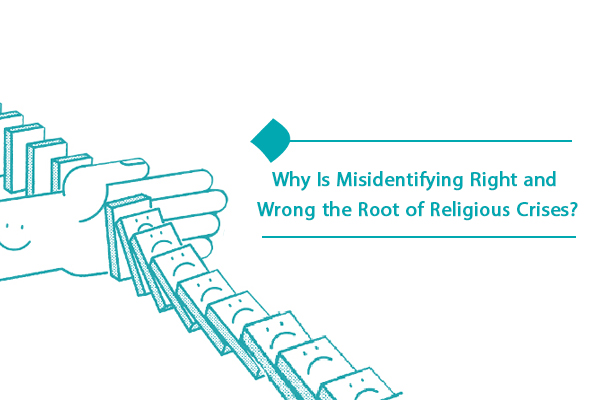
A Deep Analysis of Enjoining Right and Forbidding Wrong: Why Does the World Remain Unreformed Despite Widespread Religious Devotion?
In many religious communities, sensitivity toward right (ma’ruf) and wrong (munkar) is a well-recognized and even prominent trait. Whether in family circles, educational environments, or social settings, one often observes people reacting to certain behaviors. For instance, a family gathering might spark a debate over adhering to an ethical norm, or individuals in public spaces might protest against perceived outward improprieties. In such instances, it is commonly assumed that society is sensitive to the issue of right and wrong, and is therefore on the path to reform. However, historical and social experience demonstrates that merely increasing sensitivity toward certain behaviors does not necessarily lead to the genuine reformation of society.
To clarify this issue, consider a simple analogy. Suppose a manager in an organization devotes all their attention to the superficial discipline of the workplace: monitoring employee punctuality, strictly enforcing dress codes, and emphasizing minor administrative rules. While these actions may be useful in their own right, if that same manager remains indifferent to the organization’s primary objectives, the strategic direction of activities, or the quality of macro-level decisions, outward discipline cannot prevent the organization’s inefficiency. In such a scenario, the core problem is not a lack of detailed regulations, but rather a fundamental error in prioritizing what is truly important.
A similar pattern can be observed in individual life. Sometimes, a person focuses on a set of correct actions in their daily routine and strives to abandon certain incorrect behaviors. Yet, despite these efforts, a sense of fragmentation and aimlessness persists. In these circumstances, the problem is not necessarily a shortage of “good” behaviors; rather, it may be because these various actions are not organized around a clear and coherent axis. Consequently, even though the behaviors appear correct on the surface, they fail to result in a meaningful path.
The question arises: Does the common definition of right and wrong possess the capacity to explain and resolve the fundamental issues of individual and social life? At first glance, right is often reduced to a set of desirable behaviors, while wrong is reduced to a checklist of unpleasant behaviors. In such a definition, primary attention is directed toward the appearance of actions, with little regard for their relationship to a foundational core. The result of this approach is that a society may remain sensitive to specific behaviors while simultaneously grappling with deep-seated, systemic crises.
This situation stems from a root error in the criterion for evaluation. According to this perspective, before discussing specific instances of right and wrong, the primary criteria for identifying them must be clarified. If this standard is not correctly established, even extensive efforts to promote right or combat wrong may fail to yield the desired results. In other words, the main issue is not a lack of reformative activity, but the absence of a precise foundation for determining the correct direction of these activities.
From this viewpoint, revisiting the concept of the greatest right and the greatest wrong becomes essential. If the greatest right is correctly identified, all other right behaviors or acts will find meaning in relation to it. Similarly, if the greatest wrong is properly diagnosed, many deviations and disorders can be understood in its light. Therefore, the central question of this article is: What is the fundamental criterion for identifying the greatest right and wrong, and how can this criterion give meaning to human individual and social life?
This article seeks to first clarify the theoretical framework of this issue, then examine the position of religion’s core principle in defining right and wrong, and finally demonstrate how redefining these two concepts can transform our understanding of individual piety, social responsibility, and the direction taken by society.
The World’s Core Problem and Its Relation to Right and Wrong
Contrary to many common analyses that summarize human problems as economic poverty, social injustice, cultural weakness, or even moral deficiencies, these issues are themselves symptoms of a deeper problem. In other words, what appears globally as diverse crises is rooted in a fundamental error in identifying the axis of human guidance. As long as this axis is not properly known, no reformative effort will achieve lasting results.
Humans are not abandoned beings in the world who can determine their path solely by relying on instrumental reason or historical experience. Human life requires a meaningful order—an order that defines direction, priorities, and values. When this order is disrupted or ignored, even the most “correct” actions are misplaced. In such a state, a society may be full of religious, moral, and cultural activities, yet still suffer from internal fragmentation, conflict, and futility. This situation indicates that the core issue has not been resolved at the behavioral level, but continues to persist at the foundational level.
From a superficial perspective, right and wrong are reduced to a collection of behavioral instances: Certain acts are introduced as good and others as bad. However, without considering the criterion for evaluation, this approach inevitably leads to error. If the primary criterion is lost, the list of right and wrong actions or behaviors will also fall into chaos. In such circumstances, matters that play a fundamental role in destroying the path of guidance may be ignored, while secondary issues become the focal point of religious and social sensitivity.
The pivotal point is that the world’s greatest crisis is not a lack of law, a shortage of ethics, or structural weaknesses; it is the human disconnection from the axis of Divine Guidance. This rupture gradually manifests at various levels: at the individual level as spiritual confusion and instability, at the social level as a decline in empathy and an increase in conflict, and at the macro level as the inefficiency of value systems. From this perspective, true right and wrong must be measured based on their role in repairing or deepening this rupture, not merely on their appearance or short-term consequences.
If the world’s primary problem is not correctly diagnosed, the act of enjoining right and forbidding wrong turns into a superficial, and sometimes even inverted, activity. In this state, society may react intensely to certain outward improprieties while remaining indifferent to the root causes of deviation. The result of this approach is increased tension without genuine reform. Sustainable reform is only possible when right and wrong are redefined in relation to the world’s core problem—that is, identifying the greatest wrong as the primary cause of the rupture and the Greatest right as the point of return and reconstruction. Until this level of analysis is accepted, all efforts will remain at the level of symptoms, leaving the root cause untouched.
Wilayah and the Redefinition of the Greatest Right and Wrong
The greatest wrong cannot be reduced to a specific act or a collection of visible violations. Rather, it must be understood as a deep-rooted and all-encompassing condition. This condition is the conscious or unconscious rupture of the human being from the axis of divine guidance and a disregard for the place of wilayah (guardianship) in structuring both individual and social life. Many of the wrongs that usually become the focus of attention are, in fact, secondary consequences of this foundational rupture, not the primary cause of the crisis.
Wrong, in this sense, refers to anything that distances a person from loyalty, solidarity, and alignment with the divine path. When this disloyalty becomes a general condition, even outwardly righteous acts lose their true function and turn into scattered, directionless behaviors. The main danger in such a situation is the normalization of this rupture and its transformation into a hidden social norm.
What is important here is that, from this perspective, the greatest wrong is not necessarily accompanied by immediate or obvious reactions. A society may be highly sensitive to many visible vices while remaining indifferent to the weakening of its bond with the axis of guidance. Such indifference lays the groundwork for a hollow form of religiosity—one that, instead of connecting people, drives them apart, and instead of generating solidarity, creates a climate of judgment and conflict. For this reason, redefining the greatest wrong requires moving beyond isolated instances and paying attention to the roots of orientation in religious life.
In contrast to this foundational wrong, the greatest right does not lie in performing a single particular act, but in establishing a correct and enduring relationship. This relationship is a conscious and empathetic loyalty to the axis of divine guidance—one that gives meaning and coherence to both personal and collective life. From this perspective, right is that which anchors the human being within the orbit of divine responsibility and makes possible the harmonious growth of behavior, thought, and social action.
Before it appears in individual actions, the greatest right is an existential stance. It rescues the human being from self-centeredness and fragmentation and orders one’s existence in relation to a higher truth. The natural outcome of such a stance is an increase in empathy, a reduction in conflict, and the development of trust in human relationships. As a result, righteous deeds are no longer understood as externally imposed duties, but as the natural expression of this loyalty.
This loyalty also has tangible social consequences. It reveals itself in the way decisions are made, priorities are arranged, and collective issues are addressed. A society in which this right is strengthened will retain an inner cohesion and a shared sense of direction even when facing problems and challenges. From this perspective, enjoining right is an invitation to a fundamental return—a return that begins with correcting the relationship and ultimately leads to the correction of behaviors.
This redefinition shows that the greatest right and wrong are not two scattered concepts, but two sides of a single relationship. The stronger this relationship becomes, the smoother the path of growth for both the individual and society. The weaker it becomes, the less likely it is that even broad reform efforts will achieve lasting results.
The Individual and Social Outcomes of Redefining Right and Wrong
Based on the framework outlined in the previous sections, if the greatest wrong is defined as humanity’s rupture from the axis of divine guidance, and the greatest right as loyalty and solidarity with that axis, then the consequences of this redefinition do not remain merely theoretical. Rather, they become directly visible in both individual and social life. Humanity’s relationship with this axis is not merely a matter of belief; it is a decisive factor in shaping the inner order of the person and the outward coherence of society.
At the individual level, the first consequence of neglecting this relationship is fragmentation in religiosity and the loss of inner coherence. In such a condition, a person may perform a number of correct acts and refrain from certain incorrect behaviors, yet this collection of actions never develops into a coherent and meaningful path. Instead of moving in a shared direction, actions remain like separate islands disconnected from one another. The result is a superficial religiosity that, although outwardly visible at the behavioral level, lacks the power to create stability and peace in the depth of personal life. This condition is the direct result of losing the primary criterion for evaluating right and wrong.
By contrast, when a person’s relationship with the axis of guidance is restored, individual actions also gain meaning and direction. In such a case, religious and ethical behaviors are no longer a scattered set of obligations, but components of a single path. This coherence gradually affects the structure of the personality itself and leads to a kind of stability in decision-making and life priorities. Many moral virtues are naturally strengthened in such a state because once a person finds the overall direction of life, they also possess a clearer standard when facing conflicts and choices.
The same logic is visible at the social level. A society that loses its relationship with the axis of guidance, even if it outwardly possesses laws, structures, and reform programs, will gradually face the erosion of trust and the spread of internal conflict. In such a society, individuals and groups act according to their own limited understandings of good and evil, and as a result, a kind of fragmentation takes shape within the value system. This fragmentation not only reduces social solidarity, but also creates the conditions for unhealthy competition and mutual judgment.
In this context, the role of elites and social leaders cannot be reduced to managing executive affairs. Rather, they play a decisive part in preserving and strengthening society’s bond with the axis of guidance. When this bond is weakened at the level of social leadership, its effects quickly spread throughout the whole society, and the society’s value system falls into disorder. Conversely, when this bond is strengthened, society retains a kind of inner coherence even in difficult conditions—one that makes it possible to move through crises.
For this reason, the social consequence of redefining right and wrong is a shift in attention—from scattered reforms to the reform of society’s direction of movement. In such an approach, the effort to expand right is not limited to moral recommendations; rather, it is directed toward strengthening the foundational bonds between society and the path of divine guidance. The result of this process is the formation of an environment in which social trust, empathy, and collective responsibility are reinforced.
The issue of right and wrong cannot be examined merely at the level of individual behaviors or social regulations. These two concepts are, in fact, signs of a deeper relationship in human life—a relationship that, if properly formed, leads to the coherence of individual character and the solidarity of society; and if weakened, leaves fundamental crises intact, even in the presence of extensive efforts to reform behavior.
If we were to summarize the entire discussion in a single sentence, the main issue is this: We usually see right and wrong in scattered behaviors, while the root of all of them lies in a single foundational relationship. The greatest wrong is the human separation from the axis of divine guidance and the emergence of a kind of inner and social fragmentation. And the greatest right is a conscious and empathetic bond with that same axis—a bond that gives direction to life and allows right action to flow naturally and harmoniously from the human heart.
From this perspective, many personal and social problems arise not from a lack of effort, but from a lack of direction. When the primary relationship is corrected, smaller actions also gain meaning; when that relationship is lost, even outwardly correct behaviors fail to leave a deep effect. Therefore, understanding the most important right and wrong means identifying the central place of the wilayah of the infallible expert and seeking guidance under his authority—a guidance that can rescue both the individual and society from fragmentation and direct them toward a single, lasting path.
As a result, the greatest effort to promote right and prevent wrong is the effort toward the advent of the infallible expert and the establishment of his wilayah over society.