
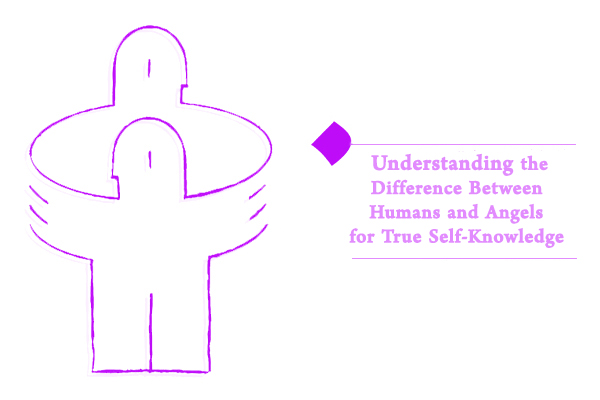
Why Are Humans Superior to Angels? An Analytical Explanation of the Difference Between Humans and Angels
When we ask ourselves what kind of beings we truly are, we inevitably wonder about the essence of angels. These two questions are deeply intertwined. Misunderstandings about human essence often arise from assuming that rationality is our ultimate essence. In truth, pure reason represents the pinnacle of angelic, not human, existence.
Without grasping the difference between humans and angels, we cannot comprehend our true place in the universe. This article clarifies this fundamental distinction through an analytical approach based on the principles of the Quran, demonstrating why true self-knowledge requires understanding the essence of Angels.

The Essence of Angels: Beings of Pure Intellect
To explore this, we must first define angels according to foundational principles of Islamic philosophy. Angels are immaterial entities lacking physical bodies, mass, dimensions, or material properties. Their reality is pure intellect, meaning they are completely free from imagination, estimation, desires, lust, or anger.
An angel being pure intellect is not a metaphor; it defines its existential core. Consequently, their internal structure consists of a single, unified faculty that only perceives truth and acts accordingly.
A being’s essence determines all its actions. Thus, saying angels are pure intellect means every function they perform manifests that single faculty. This is a key foundation for understanding the difference between humans and angels, illustrating that angels lack multiple conflicting powers, inner turmoil, or competing drives.
Why Are Angels Infallible?
The infallibility of angels does not stem from spiritual discipline, moral training, or overcoming the ego. Instead, it is a natural result of their existential makeup. We can break down the causal chain behind this perfection.
First, angels are immaterial. Matter causes change, forgetfulness, limitation, and distraction. Immaterial beings do not suffer cognitive weaknesses or perceptual errors.
Second, angels lack imagination or estimation. Human mistakes often stem from fantasies, illusory fears, or distorted mental imagery. Angels have no such faculties to conceive falsehoods.
Third, angels have no desires or lust. These are the primary forces creating tension between the intellect and desire in humans. Without them, pure intellect faces no opposition.
Fourth, an angel has only one trajectory. It perceives only truth and acts only on what truth dictates, possessing no alternative faculty to make bad choices.
Consequently, angels cannot sin. Disobedience is impossible for a being that perceives only a single directive and cannot conceive of alternatives. Angelic infallibility is an existential inevitability, serving as the first pillar in understanding the difference between humans and angels.
The Place of Intellect: An Angelic Rank, Not a Human One
Many errors related to ma’rifa, including misconceptions about human identity, stem from mistakenly defining humanity as pure intellect. This puts humans in a status that actually belongs to angels. Intellect is a noble but limited level. It comprises the entirety of an angel’s reality, but in humans, it is merely one of several faculties.
In humans, intellect coexists with other levels and faculties: senses, imagination, estimation, and the supra-rational faculty. This variety creates internal tension and necessitates choice, which angels do not experience. Therefore, the difference between humans and angels lies not just in their existential makeup but in their capacities. Humans are not merely intellect; they use it out of their own free will.
Defining oneself solely by intellect reduces a human to an angelic level. The Creator designed humans as multifaceted beings with diverse faculties and inclinations, uniquely capable of ascending beyond pure reason.
The Supra-Rational Dimension: The Unique Human Capacity for Elevation
What truly separates humans from angels is not just free will. It is a capacity that Shia philosophy refers to as the supra-rational faculty. This dimension does not oppose or replace the intellect; rather, it is a higher state of perception, witnessing, and connection that the intellect alone cannot achieve. Prophets and great spiritual figures embody the peak of this capacity. By moving past pure intellect and unlocking this higher faculty, they reach spiritual heights inaccessible to angels.
Here, the difference between humans and angels becomes fundamentally ontological. The ultimate ceiling for angels is intellect; they cannot surpass it. Humans, however, by properly using their inner faculties and desires, can go beyond the intellect and enter the elevated station of being God’s representative on earth.
Angels Serving Humanity: The Divine Order Nurturing Human Growth
The Quran frequently describes angels organizing the affairs of the universe. They execute divine commands across all realms of existence, from the falling of rain and the growth of plants to the taking of souls and the delivery of revelation. This vast scope shows that angels are not merely spiritual beings, but rather the administrative pillars of the cosmic order.
Crucially, all this planning ultimately centers on humanity. Angelic missions serve to cultivate the necessary conditions for human development. This reality reveals that the difference between humans and angels is not merely in their existential structure; rather, in the purpose of creation, humans hold the central position, and angels are subordinate to human existence.
Humans are the deputies of God, and angels function as the administrators of that deputy’s affairs. This dynamic further highlights why knowing angels is vital for self-knowledge. Without knowing their essence and role, we cannot fully appreciate the magnitude of human potential.
The Difference between Humans and Angels: The Key to Human Identity
A clear picture now emerges. Structurally, angels are pure intellect, while humans are complex, composite beings. Regarding faculties, angels lack conflicting drives, whereas humans navigate internal tension. Regarding freedom, angels are inherently bound to truth, while humans possess the power of choice. Regarding potential, angels have a limited and fixed capacity, whereas humans face an infinite horizon.
In this context, the difference between humans and angels is a core principle for understanding human identity, not a secondary issue. Defining oneself merely as intellect ignores the higher supra-rational potential and the role of divine deputyship. Assuming that angelic purity results from struggle misinterprets the human journey. Angelic purity is innate, while human elevation requires deliberate choice.
Recognizing the difference between humans and angels shows that while angels are flawless, their perfection is not chosen. Humans can achieve a level where their freely chosen purity holds greater value than innate angelic perfection.
Self-Knowledge Requires Knowing Angels
Humans cannot fully know themselves by studying their inner world. We must recognize our place among other levels of existence. Angels embody perfect intellect, while humans embody perfect will and choice. Together, they illustrate the architecture of creation.
Until the difference between humans and angels is clearly grasped, the interplay between the intellect, the supra-rational faculty, free will, spiritual elevation, and the role of angels in the World of Command (A’lam al-Amr) will remain obscured.
Knowing angels reveals a profound truth: We are not angels, nor are we meant to be. We are beings designed to ascend beyond them. Therefore, defining humanity merely by intellect denies half of our reality, while pursuing the path beyond intellect means walking a uniquely human journey designed by the Creator.