
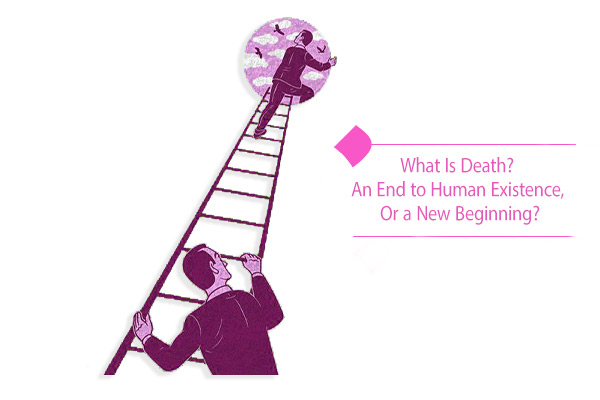
What Is Death? Will Humans Eventually Disappear?
What is death?
What exactly do we mean by ‘death’?
Is there a connection between death and birth?
Do we simply cease to exist when we die, or is there something more to our fate?
Is death limited to the body, or does the soul also die?
Death is one of those concepts that all of us have, at least once, paid attention to and sought to understand. Death has been defined in different ways, and based on our perspectives and insights, we have likely connected more with one of these meanings, accepting and understanding it more than the others. Considering the various definitions that we have of the truth of the human being, our answer to the question ‘What is death’ would also be different.
Different reasons lead us to find the true answer to ‘what is death is.’ For instance, remember that time we walked into school or work, and then, out of the blue, they told us someone had passed away? We were shocked, of course. But then, the talk turned to bigger things – what death really means, what happens after, and how it makes us think about our own lives.
The deceased person has no longer a physical presence in this world. But does that mean the end of everything for him? If we think that life ends with death, does that change the way we look at life and the way we live it?
Dictionaries define death as the end of life cycle, when all vital signs cease. But that only addresses the physical body. Two questions arise here: Are we just bodies, or is there something more? If we believe in the soul, does that change our understanding of ‘what is death?’
Different beliefs, customs, and definitions of the human being lead people to see death in different ways. In this article, we are going to examine the concept of death according to these different views. We are trying to understand if death truly marks our end, or if something more awaits us. Is it fair that everyone, regardless of their lifestyle, faces the same ending and is destroyed by death? If death means ceasing to exist, who benefits the most from such a belief? What if death means something else? Does it change how we live in the world? After exploring different perspectives which deny death, we will delve into the most profound reason for examining this concept: our desire for infinity.
How Our Beliefs and Definition of the Human Being Affect Our View about Death
Classification is a powerful tool for enhancing our understanding of everything. The same goes for how we look at ourselves. For example, our views on humanity and ourselves are influenced by whether we identify as naturalists, fitrah-oriented, materialistic, spiritually inclined, monotheistic individuals, or followers of non-Abrahamic religions.
our viewpoint even affects the way we organize our lives and define the whatness of death. Let us take a look at how the human being is defined in different ways:
– The human being is nothing more than a physical body.
– The human being has a mind as well as a body.
– The human being has a mind and soul alongside the body.
– The human is a being composed of a body, mind, soul, and spirit.
If we accept the idea that we are just bodies, then when our vital signs and heartbeat stop, we die. This means we are completely destroyed. However, accepting the following definitions would definitely change our answer to the question ‘what is death.’ For example, if accept we have a soul as well as the body, we must consider what happens to the soul when the body dies. Does the soul also die or disappear? Is our soul dependent on our body? Does the soul not have any identity or ability without the body?
To understand the answer to these questions, just think about the dreams we have. We all dream, and in our dreams, we visit different places and communicate with different people. We may even see places and people we have never encountered before, and perhaps in the future, we will see those places and travel to those places. Despite our physical bodies lying still in bed, these experiences suggest the independence of the soul, hinting at the possibility of continued life after the death of the physical body.
Belief in the immortality of the soul after the death of the body has led to various perspectives. For example, some believe that when we die, our soul leaves our body and enters a new body, and this cycle goes on forever. In other words, our soul is an eternal being that only changes its material form, i.e., its body, occasionally, sometimes appearing as a woman, sometimes as a man, and even sometimes as an insect! This idea matches with the idea of reincarnation that we have probably heard and read about.
Others believe that the soul enters another world after the death of the body and continues its life there, considering death as the end of one stage and the beginning of the next stage, or they look at it as a bridge between two different realms.
When it comes to love, hatred, or fear of death, we fall into different categories; our beliefs play a significant role in this classification. If we are really attached to life and think of death as the end of our connection with life, we will for sure hate death. However, if we believe in another world and life after death, and that how we live now affects our life there, we may either love death and be eager for it, or hate it. Such beliefs directly affect what we do. If we believe we are going to another place after this life and our life there depends on how we behave and act here, we will definitely be more cautious and will not do whatever we want.
How Belief in Justice Affects Our View about Death
Let us Imagine a world where death is defined as non-existence. How would people act in such a world? Would there be any rules to follow? We all dislike rules and limits, and we only follow them if they ultimately benefit us. It is unlikely that someone who considers death as the end of life and believes that there is no judgment or accountability after death would be hard on himself and easily forego his interests. In a world dominated by such thinking, we wonder who has the upper hand and is the winner. For sure, in those circumstances, ethical considerations become irrelevant, and in a way, the law of the jungle prevails.
If we accept this idea, the world favors those with more power and wealth, while the weaker ones will always suffer and endure hardship. It is not difficult to picture this scenario, as many of us have probably met people who have no moral compass and only care about satisfying their own needs through bullying and unethical behavior. If, by any chance, we all believe in this worldview, we can no longer have any objections; we cannot complain when someone steals our belongings or expect rewards for anything we do for others. This definition will make all rewards and punishments meaningless.
The world is structured in such a way that it can judge our good or bad deeds only to a limited extent. For instance, if capital punishment is the penalty for murder, how many times should someone who has killed thousands of people in war be executed before his punishment is fully carried out? It is not even possible for him to be executed a thousand times and still stay alive in his physical system. This suggests there must be another place beyond this world where such a person faces the consequences of his actions.
The same applies to good deeds. For instance, how should we appreciate someone who has rendered great services to humanity, built schools and hospitals, cared for orphans, and sacrificed his life in defense of moral values? How can we adequately reward all his goodness in this limited world? There must definitely be a place after death where all his good deeds are rewarded. If we are told that we will perish after death, shouldn’t we complain about this injustice? Why should someone who commits thousands of crimes be punished for only one of his actions, while another person who has spent his entire life doing good deeds receives only a small reward for his efforts? Believing that death leads to non-being is in serious contradiction with justice.
How Belief in Wisdom Affects Our View about Death
Wisdom literally means good sense and judgement, and in practice, it means performing tasks purposefully as best as possible. Most likely, we have all seen documentaries about nature, the deep sea, galaxies, or animals, and have been amazed at certain moments. Scientists in various branches of science have acknowledged the extraordinary order in every single part of the world we live in through their studies and achievements. Have we ever wondered why everything is so well-organized and delicate? Could all of this be without any purpose?
Sound reason dictates that we accept there is wisdom and reason behind this orderly and precise creation. We humans are also part of this creation, and the same rule applies to us. All dimensions of our existence and needs are arranged based on wisdom. Wisdom dictates if there is a need within us, there must be a response to it outside of us. For example, to satisfy our thirst and hunger, there is water and food available in the outside world, and the care provided by parents is a response to the needs and demands of their children.
One of the common needs in all of us is the desire for immortality, and we all want to live eternally. If we are meant to leave this world and stop existing when we die, how is our desire for immortality satisfied? If this desire is ingrained in us, there must be a response to it on the outside; otherwise, there would be a flaw in the wisdom of the system of creation. Therefore, believing that we will end up in nothingness with death is in serious contradiction with the concept of wisdom. However, the most important answer to the question ‘what is death’ lies in examining the concept of our desire for infinity.
How the Desire for Infinity Affects Our View about Death
Regardless of all the differences in perspective on the question ‘what is death,’ there is a common point among all individuals: We all strive for survival and seek to improve our living conditions. This means nothing but the desire for immortality. Why do we seek to discover the best methods of prevention and treatment of diseases? Why do we search for the Fountain of Youth in myths? Is the pursuit of rejuvenation methods related to our desire for survival?
God has created us in such a way that we constantly seek absolute perfection and the best possible state. As we have previously discussed, for every need we feel, there is a response or manifestation outside of us that can fulfill our desires. If we have a desire for immortality, there must be conditions outside of us that can meet this need. Believing that death means non-being and the end of everything is in contradiction with this truth. It is inconceivable that God gives us a desire and then creates circumstances that make fulfilling that desire impossible.
Our belief in the desire for infinity and immortality leads us to the certainty that eternity awaits, and death does not signify non-existence or an ending. We all share this desire, but the difference lies in whether we channel it with reason and valuable guidance, or let it lead us astray into superstition.
Archaeological studies show that even the earliest humans believed in a world after death and that life continues after death. Mummification, burying tools related to the deceased person’s profession with him, and even burying women alive next to kings[1] are examples of customs and traditions that prove even ancient people believed that life would not just end when someone died. These actions intended to provide comfort for the deceased person in his life after death, but their beliefs and desires were mixed with superstition. Our desire for infinity proves that death does not mean none-existence and annihilation. But does non-existence exist?
Non-Existence and Desire: Their Role in Defining Death
Some people believe that there is nothing but non-existence after death. They believe that after living their life, they will end up in nothingness and stop existing after the death of the body. But does non-existence really exist? Sometimes, the complex mind of a human has trouble understanding simple truths and is deceived by his capacity for complex thinking. One of these cases is this very question.
Non-existence is a conventional idea fabricated to describe the absence of existence. Non-existence finds its validity in the absence of existence. But in truth, non-existence or non-being cannot actually exist, because if it did, it would turn into existence. To make it clearer, if something called ‘non-existence’ exists, it itself becomes existence. When something exists, it cannot be non-existence. It does not make sense that non-existence suddenly turns into existence and still stays as non-existence. This false belief comes to the point where some people think that God created things out of non-existence. This is while nothing is outside of God’s essence, and everything is a manifestation of His essence.
In the articles on the desire for infinity, we mentioned five general characteristics for desire and came to the conclusion that all humans intuitively seek absolute perfection. So based on the characteristics of desire, we can conclude that:
1. Absolute perfection exists.
2. We are compatible with absolute perfection.
3. We have the capacity to understand absolute perfection.
4. We have knowledge about absolute perfection.
5. We have lived with absolute perfection before, and now we understand it. In other words, we have experienced being absolute and infinite.
This is why the human being is not satisfied with the limitations of life on earth. He always seeks more and more opportunities and possibilities. This is an intuitive matter, and everyone with a little inner reflection can reach this conclusion. Love for absolute, infinite perfection is not a matter of knowledge or information; it is an inherent and certain truth within human beings. We love absolute perfection. We ourselves are infinite beings because only an infinite being has the capacity for infinity, and a limited being cannot seek infinity.
Based on what we stated, infinity exists and we are compatible with it; we know it; we have the capacity for it; we have experienced it before. More importantly, we are infinite beings ourselves. As we stated before, there must be compatibility between the seeker and what is sought. So as we are the ones seeking existence, it is not possible for us to be limited. Existence is infinite and cannot be limited because only something other than existence can limit it. That thing is non-existence, and as we stated non-existence does not exist, and it is a conventional matter. So basically, in the realm of existence, there is nothing that can limit us. Then if we accept that we are infinite- logically, we have no other choice- we cannot define death as non-existence.
In this article, we discussed how there are different definitions of and views about the human being. These different perspectives lead to different definitions of death. For instance, if we think we are just this physical body, or if we believe in the existence of the body and soul together, then we might see death as either the end of everything or as the start of something new, a kind of bridge between different worlds.
Then we mentioned our desire for being infinite and stated that there has to be a response outside of us that can fulfill this desire. If we think of death as just an end to everything, then it means this desire will never be fulfilled. Also, when we think about the idea of non-existence, we realize because non-existence does not exist, basically, even if we wanted to, we could not completely stop to exist after death. We are immortal beings and have no option other than going through different phases of life, but the way we experience these phases depends on us.
If you want to learn more about the concepts of death, nothingness, non-existence, and desire for infinity, we recommend that you completely read the articles in the humanology section of the School of Humanology.
[1]. A. J. Spencer. Death in Ancient Egypt. 1st. Great Britain: Penguin Books Ltd, 1982. 68;139. Print.