
What Does the Pressure of the Grave Mean? Talking about the Home We Have Built Ourselves
Sometimes, in the midst of a religious speech or a conversation between two people, we hear words that cause unrealistic thoughts pop into our minds, words like, “the pressure of the grave.” But What does the pressure of the grave mean really?
Some people, upon hearing this question, automatically think of being squeezed between cold walls of the grave and the darkness in the grave. Others immediately respond, “Oh come on! Stop thinking about the grave and being squeezed in it. Enjoy life!” But is the matter really that simple? Or do we deceive ourselves by thinking we have enough time and there is no need to waste our time by thinking about this matter?
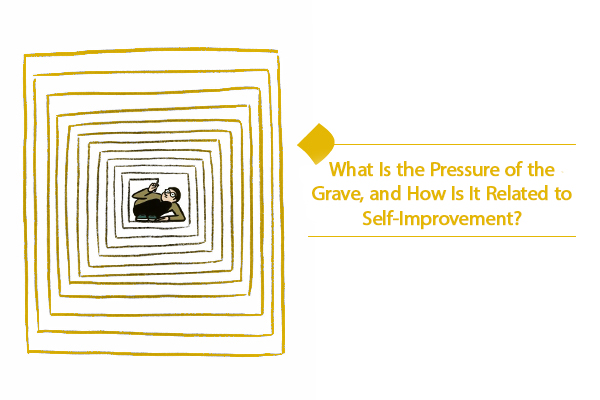
Imagine living in a house that you have built yourself; you have chosen building materials, paint colors, lighting, and ventilation. One day, that very house is going to be your eternal home. If today you measure the height of ceiling incorrectly and as a result, your house has a low ceiling, if you make a lighting mistake and the lighting in your house is terrible, and if your house has crooked walls, no matter how much you complain later, the look of the house will not change. The pressure of the grave is something like being uncomfortable in such an awkward house; we will experience in the hereafter what we have constructed in this world, without any modifications.
To better understand what the pressure of the grave means, we need to move beyond the common conception of a grave and turn our attention to our inward selves. According to Islamic self-knowledge, what happens in the grave is actually a reflection of our inward selves; that is to say, we experience exactly what we have created in life.
If we deviate from truth and justice in this world, the effect of that deviation remains within the structure of our soul. If we have diminished our spiritual capacity through negligence and bad behaviors, we will face the consequences after death. Even closing the windows of the soul to spirituality will impose constraint on us and we will stick in the dark in the Barzakh. For this reason, some people are already living with this pressure, not because of financial or social problems, but because they have made their inner self narrow and confined. The pressure of the grave is simply a continuation of this state; the difference is that there is no opportunity for change or correction in the grave or the Barzakh.
The question “What does the pressure of the grave mean?” is not just about the end of life; it serves as a warning for today. It reminds us that just as we feel uncomfortable in a small house, tight clothes, or stuffy workplace, having a small soul will cause us to feel uncomfortable. So we must cultivate our soul because we will be born with the very soul we have developed.
This article attempts to define, in clear and practical terms, what is meant by “the pressure of the grave.” While the question seems simple on the surface, it points to a critical issue about the link between our current lives and our eternal state. In the following sections, we will explore the definition and essence of the pressure of the grave, its causes, and how it precisely happens, demonstrating that this phenomenon is not a random event after death but rather a natural consequence of our choices and the way we develop our soul right now. The aim is to raise awareness and assist in reevaluating our daily lives so that we can construct a strong, bright, and spacious eternal home for ourselves from today onward.
What Is the Pressure of the Grave? The Reflection of Worldly Life in the Eternal Home
When we hear the word “grave,” most of us quickly envision a place in graveyard —a narrow, dark, and cold space where our lifeless bodies are laid to rest. However, according to the hadiths of the Infallibles and in a deeper spiritual perspective, a grave is not just a physical location; it symbolizes and embodies our inward self and the truth of our souls. Simply put, the character, beliefs, emotions, and morality we cultivate in this world become the home in which we will live after death; therefore, our grave is our soul.
When we ask what the pressure of the grave means, we must say it is the discomfort and pressure experienced in the hereafter due to the incompatibility of the soul with truth. This pressure is a completely spiritual experience; it does not mean that our body is squeezed between grave’s walls nor our muscles are crushed. Instead, it is the human soul that feels uncomfortable, suffocated, and restless in a house it has created for itself. This is the consequence for those who embrace negative and limiting characteristics in their earthly existence, resulting in a tarnished soul that will face comparable constraints in the hereafter.
Another important point is that the pressure of the grave is a natural consequence of the defective structure of the soul; just like various illnesses that we may contract if we neglect our health, it is not something imposed on us from the outside. For this reason, to protect ourselves against the pressure of the grave, it is essential to understand the mathematical structure of the soul and engage in self-improvement.
Thus, if we were to summarize what the pressure of the grave means, in one sentence, we could say it is the shape and the state of the soul after death; in other words, the pressure of the grave is a direct reflection of our actions in this worldly life, just as we have created it ourselves, with no one else responsible for its formation.
What Are the Underlying Causes of the Pressure of the Grave, and When Does the Pressure of the Grave Begin?
When we ask ourselves what the roots of the pressure of the grave are, big sins pop into our minds. However, the truth is subtler and more complex. The pressure of the grave is not a sudden event. It is not also a punishment imposed on us from the outside in the Barzakh; rather, it is the fruit of our lives that we harvest there.
Just as watering a tree with saltwater harms it, and as a result, it will bear bad fruit, if the soul is nourished with improper behavior, it will bear bitter fruit in the Barzakh. What we sow today will manifest in our soul tomorrow. If we hold false beliefs, have unhealthy relationships, or hold misguided values in life for years, our eternal home that is a manifestation of our soul will gradually lack air and be dark as well as small, and we feel a squeeze in it. These conditions may be hidden in this world by distractions and being engaged in amusements, but in the Barzakh, everything will come to light.
The roots of the pressure of the grave can be likened to underground springs that seep in from various points within us. The more contaminated these springs are, the thicker and heavier the air in our eternal home becomes. The good news is that these springs can be managed and purified in this world, provided we know where they originate.
At a general glance, there are four main factors that directly influence the expansion or constriction of the grave’s space. These four categories are, in fact, the general map of the causes of the pressure of the grave. If we understand this map well, we can build our home with breadth and light before the journey to the hereafter.
A This-Worldly Worldview
When a person believes that death is the end of everything and the earth is the only place that human begins have the opportunity to live on, everything is evaluated regarding the few decades of earthly life. Thus, the criterion for bliss is having material things, i.e., what we can see and touch, or things like home, money, beauty, or what is associated with materialistic goals like fame and fleeting pleasures. This type of outlook is like a map that shows the destination of a journey at a roadside stop; as a result, the traveler oblivious to the ongoing path ahead, squanders whatever he has right there. A materialistic person chooses the building materials for his eternal home from perishable and fragile materials—things that, at the end of life, suddenly collapse, leaving nothing but emptiness behind.
The problem is that this worldview gradually distances us from our primary goal, which is preparation for eternal life. As long as we live in this world, we are not aware of our needs in the hereafter; however, as soon as we die, our soul finds itself in a space devoid of any worldly attachments. It is here that the soul feels a squeeze because of its defective structure and its attachment to the material world. So the soul is tormented in the hereafter; this feeling of squeezing is not imposed from the outside but is a natural consequence of our own choices.
Flaws in Important Emotional and Social Relationships
Our relationships with the closest people around us—especially parents, spouses, children, and close friends—are the main pillars of the structure of our soul. If these pillars crack, the entire structure becomes unstable. The heartfelt satisfaction of parents, the annoyance or contentment of a spouse, and the trust or distrust of friends all contribute to the atmosphere of our eternal home. Sometimes, a deep heartbreak that remains unhealed acts like a hole in a wall, through which heavy and thick air enters the grave or our eternal home, making us feel suffocated.
Such flaws in relationships are usually created in silence and ignorance. May be our relationships with our parents or other people look healthy on the surface, but beneath the surface lie resentments, hidden quarrels, or subtle obliviousness that have eroded the walls of our eternal home or our soul’s structure. When a person enters the Barzakh, there is no longer an opportunity to fix these problems with an apology or compensate for our wrongs; the small flaws we have in this world transform into lasting pressures of the grave. For this reason, mending important relationships in this world is not only the key to emotional well-being but also a vital investment for a spacious grave, full of light.
Misguided Value System
All of us have an internal criterion by which we measure our success, happiness, and inner peace. If this criterion is calibrated based on things, we consider them as values while they are not, or even they are detrimental in the eyes of God—such as the pursuit of fame, unlimited wealth accumulation, having superiority complex, or believing in hedonism—then inevitably, we put all our efforts into building something that belongs to us until we die. Living this way, useless competition, endless regrets, and psychological pressures become inseparable parts of life. All these pressures accumulate like heavy burdens hanging from the ceiling of our eternal home or the structure of our soul, diminishing its strength and making it small.
A misguided value system is akin to a faulty blueprint upon which an architect builds a house; this house that may appear luxurious on the surface, but its structure is crooked, its walls are unstable, and its interior feels cramped. When we enter the hereafter, all the decorations and flashy appearances of this world are stripped away, leaving us with a crooked building—a place where its crookedness manifest as the pressure of the grave.
Negative Traits and Impurity of the Soul
Negative traits are like uninvited guests that quietly enter the home of the heart but gradually take over every corner. Jealousy sits in a corner and gnaws at peace; resentment acts like a dark fog that make us feel suffocated; greed bends the ceiling, while stinginess shuts the doors and windows. These characteristics not only leave a lasting wound on the walls of our eternal home or the structure of our soul, but also make it small and tight. So we will be less compatible with the living conditions of the hereafter, day by day.
A person who has such traits essentially builds the walls of their eternal home or the structure of their soul with coarse stones. In this world, one might hide their negative traits under the guise of artificial smiles, but in the hereafter, what is hidden will be revealed; so the scratches of the walls of our eternal home and the smallness of this home are directly perceived and experienced. At that moment, the pressure of the grave is not a false story but a stark reflection of those very walls we have constructed with our own hands and choices.
These four general categories are merely a broad classification of the causes of the pressure of the grave. Each one has dozens of branches and examples, and a thorough examination and understanding of them can be the key to building a spacious, bright, and peaceful eternal home or a healthy soul, which we will explore in future articles.
Examining the Pressure of the Grave Through Three Tangible Metaphors
To understand how the pressure of the grave happens, we must start from a key point: The human soul is its true eternal home. This home is constructed based on our alignment or misalignment with “truth” and the path of perfection. Whenever we make a decision, hold a belief, or behave in a way that contradicts the truth, it is as if we are building a wall crookedly or failing to set a column in its rightful place. In the short term, the appearance of the house may seem fine, but over time, the crooked walls will crack and the columns will bend, making the house distorted. In the hereafter, where all veils are lifted, and we will see our eternal home exactly as it is; this is an actual answer to the question “What does the pressure of the grave mean?” To clarify this concept further, let us explore three tangible examples.
- a) The Relationship Between the Womb and the Type of Birth
The fetus develops in the womb of the mother that is a limited space. However, it is suitable for that stage of life. If something interferes with the fetus’s growth—such as an organ being compressed or tissue becoming malformed—this defect will manifest upon birth. Entering the hereafter is akin to the soul’s birth from the womb of this world into the next; if the structure of the soul has not been properly formed in this life, it will feel a squeeze in the form of the pressure of the grave after death, leading to an unhealthy birth into the hereafter.
- b) Building a House
Imagine you intentionally build bowed walls for your house to use less ground space. You might not see any issues in the layout, but the moment you move to the house, you immediately feel suffocated and cramped. Every moral or ideological deviation imposes such pressure on the soul.
- c) The Relationship Between a Parent and Child
A child who grows up in a restricted emotional space or under the shadow of unbalanced parental behavior, develops a feeling of constriction and limitation within their soul. This experience later repeats itself in their social relationships or even their inner self. The pressure of the grave is similar: a reflection of the internal compressions and psychological pressures that we ourselves have injected into our soul through our lifestyle.
In essence, the inner turmoil we carry today—be it anxiety, jealousy, or accumulated fear and rage—persists unfiltered at the border of death and the hereafter, i.e., the Barzakh, if left unaddressed. We then remain with our souls, exposed and in the exact state we have shaped them. This is where we find a clear answer to the question, “What does the pressure of the grave mean?”: a true image of the home we have designed and now must inhabit forever.
The pressure of the grave is not a terrifying and vague event. It does not also occur in the ground; rather, it is a reflection of the quality of our spiritual and moral life. What we have built throughout our lives through our beliefs, relationships, values, and traits will be directly experienced after death. Just as the flawed architecture of a house causes its inhabitants discomfort and suffering, the misalignment of our souls in this world leads us to feel a squeeze and suffocated in the hereafter.
The question of what the pressure of the grave means, in essence, invites us to reconsider ourselves, while we still have the opportunity to live in this world. So we should straighten the crooked walls, mend damaged relationships, align our values with the truth, and remove negative traits from the home of our hearts. This is because tomorrow, the house where we live in the hereafter will not be a mysterious gift but rather exactly what we have built with our own choices today.