
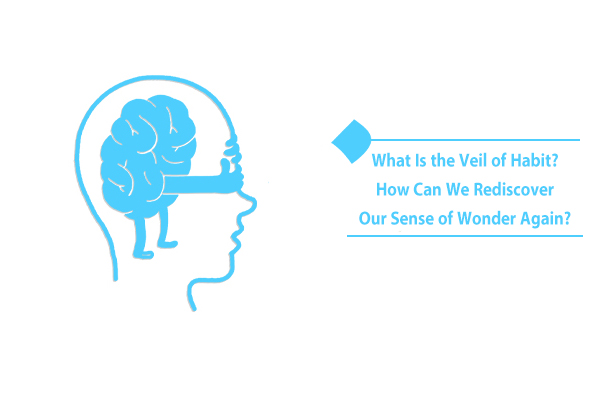
The Veil of Habit—The Silent Killer of Gratitude and Growth
Have you ever woken up, picked up your phone, opened the window, poured yourself a cup of tea, and started your day—without even once pausing to reflect on how strange, beautiful, and astonishing these actions truly are?
- How do you view the blessings and phenomena around you: with curiosity or simply out of habit?
- In your opinion, what causes even the most extraordinary occurrences to become ordinary to us?
- Have you ever managed, before eating a fruit, to pause and truly observe it—look at it carefully, smell its fragrance, admire its color—and only then enjoy eating it?
We human beings have become so accustomed to witnessing the daily blessings and wonders of the world that we often forget how much gratitude we owe for them. In fact, what prevents us from perceiving beauty and enjoying life is a thick veil known as the veil of habit.
This very veil is what keeps us from recognizing the value of our eyes, tongue, ears, breathing, thinking—or even something as simple as a glass of water. It is only when we lose one of these blessings that we come to realize what a priceless asset we had been taking for granted.
Even today’s children have become so accustomed to airplanes, cars, mobile phones, and the internet that they are no longer amazed by them as earlier generations once were—unaware that behind these technologies lie the tireless efforts, vast knowledge, and even the lives of many individuals.
But is it possible to lift the veil of habit? Can we look at life once again with fresh, awakened eyes?
Before arriving at an answer, let us first examine some of the most significant examples of the veil of habit.
Which Blessings Have Become Ordinary? | Examples of the Veil of Habit
As mentioned in the introduction, the veil of habit is one of the most difficult obstacles on the path of human growth and self-transcendence. This veil prevents us from truly understanding divine knowledge. One significant example we have grown accustomed to—often failing to make proper use of it—is prayer. Although prayer is the ascension of the believer and serves as the essential nourishment that must reach the human dimension of our being each day, it should never feel repetitive or monotonous to us. However, due to the veil of habit, we engage with prayer only on a verbal and superficial level. This shallow connection prevents prayer from transmitting the energy and transformative power it inherently carries.
The veil of habit can even cause us to forget the greatness within ourselves and others. Sometimes, it leads to disrespect or belittlement of individuals who hold an exalted status before Allah and the Household of the Prophet Muhammad (Peace be upon them), despite their lofty rank in the sight of God. This veil may cause a person to live for years in the presence of the Infallible Imams (Peace be upon them), yet fail to benefit from their spiritual and divine presence [1].
Falling into the grip of the veil of habit also prevents one from perceiving the kindnesses of Allah, the Infallible Imams (Peace be upom them), and the angels. Consequently, the blessings and goodness surrounding us go unnoticed. For instance, becoming accustomed to the efforts of our parents or spouses may lead us to overlook and fail to appreciate their sacrifices, unaware that these very efforts are among God’s blessings. At times, this state becomes so deeply rooted that Allah, through the occurrence of hardships and afflictions, tears away this veil of habit—so that the human being may once again become aware, reflect, and return to gratitude. Now that we have become acquainted with the most important examples of the veil of habit, it is time to explore strategies for overcoming this barrier.
How to See Everything Anew through the Eyes of a Child: Removing the Veil of Habit with a Fresh Perspective
The first step in training ourselves to see rightly is to remove the lens that makes the events of the world appear ordinary. We must learn to look at the world as children do—seeing everything as new. Children gaze at the world with wonder and curiosity because it is their first time encountering things; nothing feels repetitive or familiar to them.
If we seek to lift the veil of habit from our sight, we must approach all things with a fresh perspective, not through the filter of routine and out of habit. Just like a medical student who attends class or takes part in a dissection session fully aware that he is engaging with a highly specialized and complex matter, we too must carry that mindset into our everyday observations. There are countless ways to practice this kind of fresh perspective—such as reflecting on the intricate details of anything Allah has created. For example, observe a child and recall their origins: once a mere drop of fluid, now transformed into a being of such delicacy, beauty, and a wide range of emotional expressions.
Another path to overcoming the veil of habit is through reflecting on the realities of the Day of Judgment, the Hereafter, Heaven and the blessings it holds. For instance, by closely observing the colors and fragrances of fruits, examining their seeds, and contemplating their beauty, we begin to uncover the wisdom of their Creator. Yet under the veil of habit, these signs often go unnoticed.
When we observe creation without the filter of habit, our sense of wonder is awakened, and we are moved to prostration. The Almighty has fashioned every phenomenon in this world out of His love for us and for our sake. It is not befitting to pass by them heedlessly. If we take the time to truly observe a flower and its petals, imagining how the angels have delicately shaped each part, we begin to understand its real worth. We also come to recognize our own value—how beloved we are to God, who created the entire universe for us. Reflection can elevate us to the highest ranks—even if it lasts only five minutes! Simply holding a fruit and pondering its color, taste, fragrance, structure, properties, and effects can have an impact on the soul equal to years of worship. This is because such contemplation draws us nearer to God’s power, wisdom, and beauty.
Gratitude: A Bridge to Rediscover Wonders and Remove the Veil of Habit
Another effective way to lift the veil of habit is through gratitude—consciously giving thanks for the blessings God has bestowed upon us. Many of the illnesses, hardships, bad tempers, and tensions we face in life stem from our own ingratitude. Often, when we sit down to eat, we do not pause for even a moment to reflect on who has granted us the blessings before us. Many of us cannot even recall the last time we said “All praise is for Allah—Lord of all worlds [2]” after drinking water—yet the simple act of drinking water is a tremendous blessing in itself. It may be hard to believe, but for some people—such as certain cancer patients—this very water, so smooth and easy for most of us, does not pass easily down their throat.
If we succeed in removing the veil of habit and begin to reflect on each and every blessing of God, we will find ourselves immersed in a sea of divine light, insight, strength, and spiritual momentum. At times, in order to prevent us from becoming indifferent to life’s wonders, God disrupts the usual balance of our lives—just so we might awaken to the blessings we had taken for granted.
In this lesson, we discussed the veil of habit and explored several of its key examples. We also introduced two essential strategies for breaking through this barrier. If we truly wish to open our eyes to the truth, we must train ourselves to look carefully, reflect deeply, and practice gratitude. Removing the veil of habit is not a one-time task—it is a lifelong practice.
What other strategies do you think can help in this journey?
References
[1]. The Messenger of God (Peace be upon him) said, “The relatives and neighbors of A learned man receives least attention from his relatives and neighbors.” (Al-Muttaqi al-Hindi, Ala al-Din ‘Ali ibn ‘Abd-al-Malik Husam al-Din. Kanz al-Ummal Fee Sunan al-Aqwal wa al-Af’al. Generic, 2022.)
[2]. Alhamdulillahi rabbil Alamin (Quran, 1:2)