
What Is the Importance of Knowing the Scales of the Hereafter in Our Life?
In previous lessons, we discussed the concept of scale and evaluating our deeds. We mentioned that we are constantly weighing our actions. This weighing is a constant practice; thus, rather than needing knowledge and information, we require specific indicators and measures for each action. Without these measures, we can fall into extremes. For example, if a doctor lacks the necessary understanding of normal health indicators—like iron, calcium, vitamin D, blood sugar, and cholesterol—they won’t be able to diagnose illnesses or treat patients effectively.
Do you think there are proper measures or standards we can use to evaluate our rationality, courage, sincerity, self-sacrifice, truthfulness, piety, or the correctness of our prayers and fasting?
Certainly, having accurate measures and scales on our journey toward eternity is even more important because the tools we need for the Hereafter aren’t our physical bodies but rather our hearts and souls. Keeping them healthy is far more crucial than maintaining our physical health. To enter the living conditions of the Hereafter, we need a sound heart, which requires an understanding of the scales of the Hereafter and the precise measures to which our hearts must align.
As long as we lack proper measures and standards for our actions, we cannot be sure whether an action we perform—one that seems to have great reward—will actually benefit us. We might become so focused on religious and worshipful practices that we neglect our primary duties. For instance, during the Sacred Defense period, many seminary students became so engrossed in studying jurisprudence that they missed out on participating in jihad, fighting against the enemy. In this way, Satan distracts us with good and sacred actions so that we overlook our essential responsibilities.
In this article, we aim to introduce and explore the most important scales of the Hereafter. Stay with us.
Knowing the Most Important Stations and Scales of the Hereafter
As mentioned in the introduction, it is necessary for everyone to know the scales of the Hereafter to avoid suffering and torment on the Day of Judgment. Knowing the crucial stations (mawāqif) and scales of the Hereafter is the first step toward preparing for a healthy birth into eternal life. The next step is to implement and embody these measures and scales within ourselves. Each of us has multiple measures based on our roles and positions in life, and every action we take is evaluated against one of these measures.
Some of these measures play a crucial role and can help us correct deficiencies in other areas; however, some measures cannot be reformed if they are flawed. For instance, doctors may improve a patient’s condition by diagnosing and prescribing treatment, but there are cases where a patient’s situation is such that no cure is possible. Similarly, when evaluating our deeds, neglecting daily prayers and failing to fulfill our individual duties toward the Imam of our Time (May Allah hasten his reappearance) are serious matters for which we will be held accountable on the Day of Judgment.
In the following sections, we will discuss some of the most significant scales of the Hereafter.
The Scale and Our Connection with Our Heavenly Family
The most important station of Resurrection is that of the Imam of the Time, Imam Mahdi (Peace be upon him). At this station, we will be questioned about the quality of our relationship with Imam Mahdi (Peace be upon him) and whether, as his children and as a Shia, we have acted according to the standards related to him and if our scales are sufficiently filled and acceptable. We must consider whether our decisions, relationships, thoughts, behaviors, and overall lifestyle align with the Noble Rule of the Imam Mahdi (Peace be upon him) and the concept of awaiting his return.
Most people claim love for Imam of the Time (Peace be upon him), but few truly believe in their father-child relationship; while all of us before being someone’s father, mother, spouse, child, employee or boss, are children of Imam of our Time (PBUH). We need to feel responsibility towards this lonely and oppressed father of ours who continues to weep day and night after centuries of solitude and distress.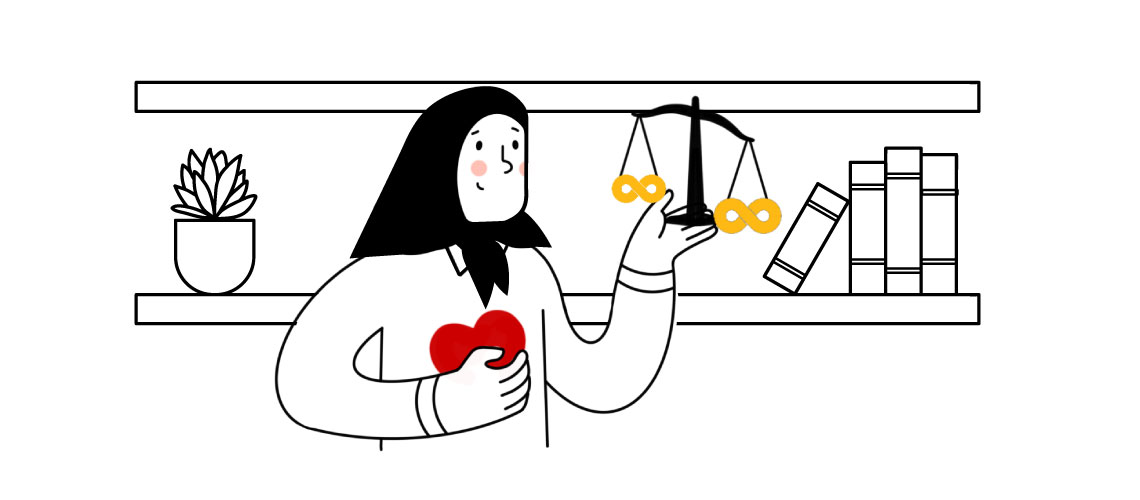
The Relationship Between the Scale and Prayer
Prayer has a series of scales or standards that we must correctly understand and strive to fulfill. If we do not, we could be praying for decades without even a one of our prayers being accepted [1]. This indicates that we have not adhered to the standards of prayer. When we talk about prayer, there are two key aspects: correctness and acceptance. The correctness of prayer pertains to its outward form and structure; this means that ablution (wudu), recitation (qira’ah), bowing (ruku), prostration (sujud), and other pillars of prayer must be performed correctly. However, the acceptance of prayer relates to its inward form and essence. Our prayers should be pleasing to God and uplift our souls. There are times when our prayers might be technically correct—fulfilling our obligations—but they might not help us grow spiritually or ascend. It’s similar to a student who gets good grades through dishonest means; what looks good on paper doesn’t reflect real knowledge or understanding. To determine whether our prayer has been accepted, we must observe how much it prevents us from sin [2]. If our prayers lead us away from impurity and corruption, they are more likely to be accepted. Conversely, if we find ourselves praying yet still engaging in injustice or failing to distinguish between what is permissible (halal) and forbidden (haram), it’s a sign that something is off with our prayers—they may not be pleasing to God [3].
The Role of Fathers in Filling the Scales of the Hereafter
As we discussed, everyone has a responsibility to fill their scales of the Hereafter. For fathers, this ‘full or heavy scale’ means guiding their family towards knowing Allah and understanding the Hereafter [4]. If they neglect this responsibility, they will flee from their family on the Day of Judgment [5] because they have not truly fulfilled their duties as fathers.
A father’s duty extends beyond themselves; they should be knowledgeable about obligatory acts (wajibat) and actively teach them to their family. Unfortunately, many fathers tend to prioritize their children’s academic achievements, degrees, or social status over their spiritual development and moral character. While these worldly pursuits are important, they shouldn’t overshadow the essential task of nurturing faith and preparing for the Hereafter. Woe to the parents who are concerned about their children’s worldly life but neglect their Hereafter [6]!
In this lesson, we highlighted the importance of knowing the scales and aligning our deeds accordingly. We also shared some examples of crucial scales of the Hereafter. What other scales of the Hereafter do you think are important? We look forward to hearing your valuable experiences and insights on this topic.
References
[1]. Imam Sadiq (PBUH) said: “By Allah, a man may reach fifty years of age without having a single prayer accepted by Allah. So, what could be worse than this?” (Al-Kulayni, Muhammad ibn Ya‘qub. Al-Kafi. Researched and corrected by Ali Akbar Ghaffari and Muhammad Akhundi, 4th ed., vol. 3, Dar al-Kutub al-Islamiyyah, 1407 AH, p. 269.)
[2]. Imam Sadiq (PBUH) said: “Whoever wishes to know whether his prayer has been accepted or not, let him observe: Has his prayer restrained him from indecency and wrongdoing? To the extent it has restrained him, it has been accepted.” (Tabarsi, Fadl ibn Hasan. Majma‘ al-Bayan fi Tafsir al-Qur’an. Corrected by Fadlullah Yazdi Tabatabai and Hashim Rasuli, 3rd ed., vol. 8, Nasir Khosrow, 1372, p. 447.).
[3]. It was said to the Messenger of Allah (PBUH): “Such-and-such woman fasts during the day, stands in prayer at night, gives charity constantly, yet she harms her neighbor with her tongue.”
He (PBUH) replied: “There is no good in her worship—she is from the people of the Fire…”
(Al-Noori, Husayn ibn Muhammad Taqi. Mustadrak al-Wasa’il. Corrected by the Ahl al-Bayt Institute (AS) for Reviving Heritage, vol. 8, Ahl al-Bayt (AS) Institute for Reviving Heritage, 1408-1409 AH, p. 423.).
[4]. Imam Ali (PBUH) said “No one will meet Allah with a sin greater than neglecting the ignorance (lack of religious knowledge) of their family and children.”
(Fayd Kashani, Mulla Muhsin. Al-Mahajjat al-Baydha, vol. 3, p. 73.)
[5]. Quran, 80:34-36
[6]. The Prophet (PBUH) is reported to have said: “He looked at some children and declared: ‘Woe unto the children of the End Times because of their fathers!’ Someone asked: ‘O Messenger of Allah, do you mean their polytheist fathers?’ He replied: ‘No, their believing fathers! For they fail to teach them the religious obligations, and when their children attempt to learn, they prevent them – being satisfied with trivial worldly gains instead. I renounce them, and they are renounced from me.'”
(al-Shuʿayrī, Muḥammad ibn Muḥammad. Jāmiʿ al-Akhbār. 1st ed., Haydariyya Press, n.d., p. 106.)
Comments and questions
Ask a question or share your experience with this lesson.
After signing in and enrolling, you can join the discussion.
Be the first to ask a question about this lesson.