
Who Is a Religious Person? Objective Indicators in Analyzing the Markers of Faith
Imagine a young gardener who plants a tree and obsessively waters, sprays, and prunes it every day. From afar, the tree looks flawless, vibrant, and well-tended; yet as the years pass, it bears no fruit on its branches. Elsewhere, a mother feeds her newborn with the finest nutrition, but despite constantly receiving food, the child fails to gain weight or grow taller, remaining frail. In both cases, there is a fundamental flaw: a lack of absorption and an absence of fruit. In biological systems, failing to produce fruit or absorb nutrients points to a structural crisis within the organism, even if routine inputs—like watering or feeding—continue.
This perfectly illustrates a state in the realm of human belief known as surface-level or stereotypical religiosity. Many people do religious rituals out of habit, but when life gets tough, it quickly shows that their practice is empty on the inside. Weariness and disillusionment with worship stem directly from this fruitless structure. Just as we do not grow tired of eating good food or using conveniences like cars—because we experience their tangible benefits every time—growing tired of an act of worship like prayer indicates a lack of inner reception. True faith must bear real, visible fruit that goes far beyond empty rituals. To evaluate this, we need indicators that show whether faith has truly settled within a person’s core. These indicators are explained through three key components, serving as the markers of faith.
How Faith Shows in Our Actions: The First Marker of Faith
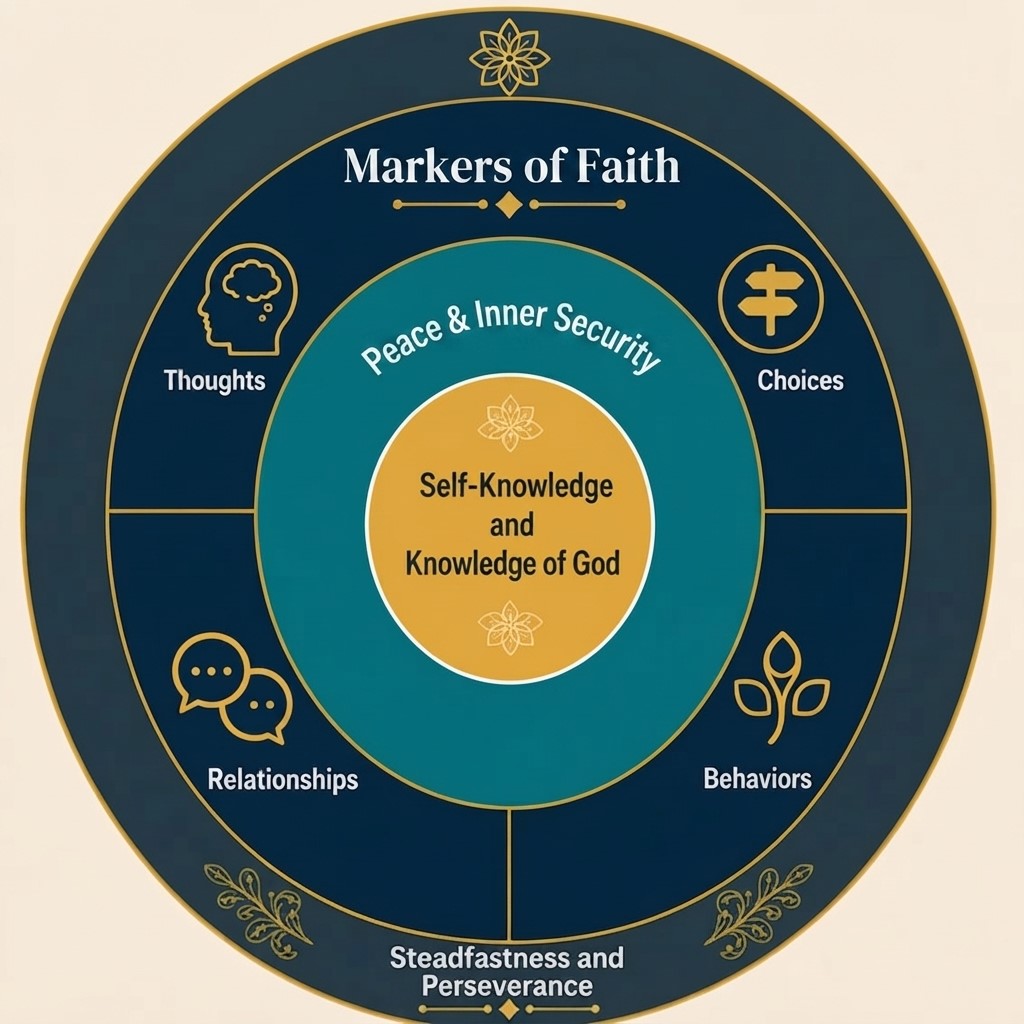
The first and most tangible indicator for evaluating the depth of a person’s religiosity is analyzing their decision-making and behavioral patterns in daily life. A truly religious person surrenders their personal will to the Divine in four core areas of life
- Choices: Crucial life decisions, ranging from choosing a spouse to career paths.
- Relationships: How we connect and bond with other people and our community.
- Behaviors: Our daily outward actions and practical, everyday conduct.
- Thoughts: Our mindset, inner reflections, and deepest beliefs.
In this framework, the primary benchmark is moving beyond personal preferences and base desires. A genuinely religious individual does not allow their personal likes or dislikes to interfere in these four areas; instead, they take direction straight from the Divine will. They do not form attachments to any phenomenon, person, or material possession based on mere whims. Rather, they leave the assessment of benefit and harm—what to love and what to reject—to religion.
One of the most prominent manifestations of this submission is aligning one’s love and hate with Divine standards. As Islamic narrations state, anyone whose love and enmity are not rooted in religion is devoid of its true essence [1]. In social behavior, deviating from this standard manifests as prejudice or bias. For instance, putting ethnic, tribal, or political biases ahead of divine principles when making major decisions—like voting or choosing a spouse—shows that a person has drifted away from true faith and is instead guided by personal whims. Ultimately, aligning one’s behavioral compass with the Divine will is the most accurate test of real faith.
Peace and Inner Security: The Second Indicator in Assessing the Markers of Faith
The second indicator of genuine faith is the cultivation of peace, happiness, and inner security. Superficial religiosity—existing merely at a mental level without penetrating the soul—cannot transform a person’s psychological structure. Just as failing to absorb nutrients stunts a newborn’s growth, failing to absorb religious truths into the deeper layers of one’s personality prevents the formation of inner peace. For religion to be effective, it must find a receptive affinity within the soul. In other words, one must identify that dimension of their existence which is inherently in need of the Absolute in order to respond to it appropriately.
Many who have prayed and observed the hijab for years, only to ultimately find themselves in conflict with religious teachings, suffer from this exact deficiency: religion accumulated in their minds but was never absorbed into their souls. This mental accumulation, devoid of inner impact, is beautifully captured in poetry:
No plague is worse than not knowing (Him).
Thou art beside the Beloved, and knowest not how to cast (thy) love (upon Him) [2].
Reciting words of worship during prayer without perceiving the reality of the One being addressed, and without establishing a living presence with Him, renders the act of worship ineffective. In truth, uttering phrases like “You (alone) we worship; You (alone) we ask for help [3]” becomes meaningful and comforting only when a person attains self-knowledge, recognizes their deep need for an unparalleled anchor, and finds Him to be the ultimate answer to their existence.
Resorting to temporary relievers, such as psychiatric medications, when facing life’s hardships indicates a weak bond between the soul and the Creator. When an individual cannot find joy through a connection to the Source of Existence, their God is practically perceived as a weak deity incapable of helping them—whereas the Quran explicitly asks: “Is not Allah sufficient for His servant” [4]? Connecting to infinite Divine power should make a person independent of all else. Consequently, the degree of peace and inner security maintained in the face of adversity serves as a vital scale in evaluating the markers of faith.
Steadfastness and Self-Knowledge: Resilience in Crises as a Sign of Faith
The third and final indicator for measuring the depth of religiosity is steadfastness and resilience in critical or corrupt environments. The source from which one draws faith determines its longevity. When faith is acquired purely by imitating parents or following social figures, it falters whenever the environment changes or role models stumble. In contrast, religiosity rooted in self-knowledge and a direct understanding of the Divine possesses such stability that it keeps a person pure and steadfast even in the most toxic and challenging circumstances.
According to the teachings of the infallible Imams, faltering in faith is the byproduct of imitation without insight, whereas a path driven by true knowledge is unshakable. As Imam Sadiq (Peace be upon him) states: “Whoever enters [the faith] through the Book and the Sunnah, mountains will move before he wavers” [5] Furthermore, an abundance of outward worship does not necessarily equate to true religiosity. As Imam Ali (Peace be upon him) states: “How many a devout ritualist has no true religion” [6], implying that many persist in external rituals yet remain devoid of religion’s true essence. The true signs of a living, lasting faith in one’s life are:
-Good character and kind conduct toward others
-Fostering safety for oneself and society
-Enduring inner peace amidst the fluctuations of life
-Trustworthiness in both material and spiritual dimensions
These traits become institutionalized within a person only when religion has been properly absorbed and has established an organic relationship with their existence. In this light, the steadfastness of an individual anchored in ma’rifa within corrupt environments serves as clear proof that the markers of faith have taken deep root.

Actively Measuring the Markers of Faith in Daily Life
Through a comprehensive analysis of the various dimensions of faith, it becomes clear that true belief is not merely an abstract concept or a product of the mind. Rather, it is an objective, dynamic, and impactful reality across all layers of human life. To evaluate this personally, anyone can review their daily behaviors: Are our decisions at life’s crossroads based on personal whims or Divine decree? Do our daily acts of worship lead to inner peace and vitality, or are they merely the repetition of a draining habit? And finally, do our beliefs remain steadfast during environmental turbulence?
The answers to these questions determine how closely we align with the truth of religion. Therefore, continuously evaluating our behaviors across those four realms, our level of spiritual peace, and our resilience in crises serves as the most precise tool for measuring genuine religiosity—guiding us away from stereotypical rituals and toward a fruitful faith.
References
[1]. Muhammad ibn Ya‘qub al-Kulayni. Al-Kafi. Vol. 2, Chapter on “Loving for the Sake of Allah and Hating for the Sake of Allah,” Hadith 16.
[2]. Rumi, The Mathnawí of Jalálu’ddín Rúmí. Translated by R. A. Nicholson, vol. 5, Book 3, verse 3918, Luzac & Co., 1929.
[3]. Quran, 1:5
[4]. Quran, 39:36
[5]. Mohammad-Baqir al-Majlisi. Bihar al-Anwar. Translated by Sayyid Hussein Alamdar, vol. 2, p. 105. Ansariyan Publications, 2021.
[6]. Abd al-Wahid al-Amidi. Ghurar al-Hikam wa Durar al-Kalim (Exalted Aphorisms and Pearls of Speech). Translated by Tahir Ridha Jaffer, “The Devotee,” saying no. 1. Ansariyan Publications, 2012.