
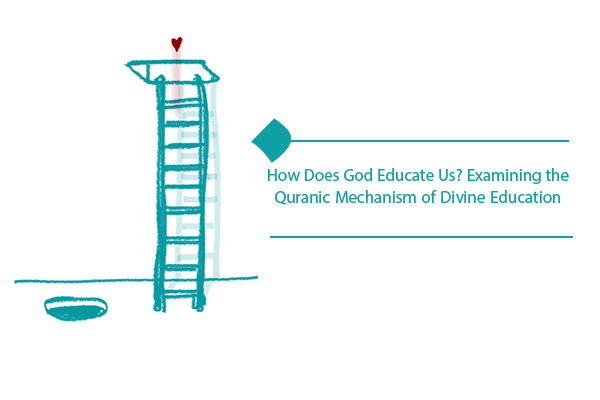
The Logic of Human Growth: Understanding Divine Education through Participation
Imagine you want to teach your younger brother self-confidence and problem-solving skills. If you constantly make decisions for him, he will always remain dependent on others. But what would happen if one day, in the middle of a minor crisis (like losing the house key or a broken door lock), you tell him: “My hands are tied right now. Please find a way to open this door yourself; I can only guide you”?
In that moment, you might appear helpless on the surface, but underneath, you are engineering a breakthrough. You have moved him from being a passive spectator waiting for others to fix things to being at the very center of the situation. Now, it is up to him to think, choose the right tools, and own the results. Your apparent need for his help is, in reality, an educational investment in his growth.
This scenario perfectly illustrates the model of Divine education. God, as the ultimate Educator of creation, needs none of our possessions, help, or worship. However, His invitation to participate rests on this very logic: pulling human beings out of passivity. We are called to this path not to fulfill God’s needs, but because it is through this process that we ourselves are formed and transformed.
The central question of this article is: If God is absolutely self-sufficient, why does the Quran employ the language of request, commanding charity, or even asking for a ‘loan to God’ [1]? Are these phrases merely literary devices, or is there an educational logic behind them?
This paper aims to show that a significant portion of religious discourse must be understood within the framework of the mechanism of Divine education, where humans are not merely commanded to obey, but are invited to grow, participate, and evolve. From this perspective, religion is not just a collection of duties; it is a framework designed to transition individuals from passivity to active moral agency.
Why Human Growth Requires Frameworks and Rules
In the Quranic worldview, human beings are not abandoned travelers drifting through existence simply to pass the time or accumulate information. Their ultimate purpose is a profound existential transformation: “becoming.” There is a vast gap between merely knowing moral principles and actually becoming a generous, patient, and just person. From this viewpoint, Divine education does not consist of scattered, unrelated duties; it is a structured model for humans to gradually be adorned with Divine attributes and virtues such as mercy, forgiveness, forbearance, and justice.
Conventional forms of human knowledge—ranging from empirical sciences to management skills—enhance our capacity for analysis, understanding, and planning, but they cannot intrinsically alter human character. A person can be a brilliant scientist yet remain selfish, fearful, or greedy. What truly elevates a human being is the formation of genuine virtues in the soul. Within this framework, religion is not a control system designed to restrict freedom; rather, it is a mechanism to actualize the latent spiritual potential in humans—a path of striving to transcend personal limitations and draw closer to Absolute Perfection.
But how does such a transformation happen in practice? Any relationship requires rules to endure and bear fruit. Consider a family or romantic relationship: Initial intimacy and affection remain fragile and vulnerable unless they develop into commitment, clear boundaries, and mutual responsibility. Feelings alone cannot sustain a relationship in times of crisis unless they are embodied in consistent patterns of behavior.
The same principle applies to the relationship between human beings and God. If the relationship with our Creator is to be lasting, nurturing, and deep, it requires a system of commands and guidance. Religious commandments (from personal acts of worship to moral and social guidelines) are essentially the rules that sustain this relationship. Far from being walls meant to imprison us, these guidelines are tracks that keep our scattered minds and actions from falling into chaos, directing us toward inner focus and unity.
Divine Education: When His Words Seem to Ask for Something
One of the most profound manifestations of Divine education in the Quran is found in addresses that, on the surface, seem to ask something of humans: give charity [2], lend to God [3], spend in His cause [4]. Superficially, those unfamiliar with the true nature of the human being and lacking self-knowledge might misinterpret these expressions as signs of Divine need. However, a deeper look reveals that the true purpose is to guide humans beyond passivity and into the realm of Divine mercy. When an individual is asked to give, they enter a sphere of active influence and elevate their own self through action.
According to this logic, the command to give charity is not merely a transfer of wealth. Giving is an exercise in transcending self-absorption and stepping into the realm of kiramah (dignity and generosity). A person who gives does not just decrease their possessions; they loosen their attachment to ownership. They learn that the essence of their existence is not defined by possessing or accumulating, while simultaneously confronting Satan’s fear-based temptations. The true meaning of Divine education becomes clear here: Through the very way God addresses us, He empowers human beings to abandon passivity and take command of their moral choices.

Divine Education and the Paradigm of Ashura
While the logic of charity operates at an individual and everyday level, the paradigm of Ashura highlights it on an existential and historical scale. In the event of Karbala, the call “Is there any helper to help me?” (Hal min naṣirin yanṣuruni) [5] appeared on the surface as a call for help. Deep down, however, it was an invitation for human elevation. The reality was not that Imam Hussain (Peace be upon him) was in literal need of physical assistance; rather, his call was an invitation for his followers to transition from passive onlookers to active agents. By standing up for truth, individuals were ultimately cultivating themselves.
This is one of the highest points in understanding Divine education. In Ashura, helping God’s Proof (Hujjatullah; His deputy) is not about aiding an external truth for its own sake; it liberates humans from fragmentation, fear, inaction, self-interest, comfort-seeking, and the confines of a merely animalistic existence. Whoever stands in that arena connects themselves to a truth far greater than their immediate interests. Thus, Karbala is not just a historical event; it is a pedagogical model showing how confronting the truth prompts humans to move beyond simple claims to their practical realization. This is precisely where Divine education transforms from a concept into a lived experience.
Divine Education and Cultivating the True Self
Humans were not created merely to experience the world; they were brought here to be edified. Every religious command, when properly understood, is part of the process of constructing one’s true self. Prayer, fasting, pilgrimage, zakat, hijab, and other religious commandments lose part of their meaning if viewed strictly as formal obligations. These acts are, at their core, practical manifestations of an existential movement: moving from fragmentation to integration, from negligence to presence, from self-sufficiency to a conscious reliance on the truth.
At this level, Divine education means that God uses various tools to guide humans from the outward level into the deeper dimensions of being. Every act of worship is an exercise in transformation—a transformation that is neither purely psychological nor merely behavioral, but a change in the very way a human being exists. Therefore, anyone who takes rituals seriously yet ignores internal transformation has not yet properly understood their purpose. Religious commandments are the tools for cultivating the human, and the human being is the product of this cultivation process. Consequently, this transformation must become visible in one’s moral character, will, and relationships with others.
Divine Education in Daily Life
To understand this logic in practical terms, we only need to reflect on our daily lives. Wherever a person only receives and never gives, they remain at a lower level of existence. Wherever someone merely waits instead of participating, they remain distant from this process of education. Whenever a person views rules as obstacles rather than tools for character development, they have not properly understood their relationship with religion. Conversely, any decision that brings a person out of passivity and leads them toward responsibility, generosity, commitment, and presence is a part of this Divine education.
From this perspective, a life of faith means a life lived in the process of becoming. In every situation, one must ask: “What is this situation making of me? Is it keeping me as a passive consumer, or is it leading me to active agency? Is it leading me into repetitive habits, or guiding me toward a Divine attribute?” These questions are the practical expression of Divine education. Ultimately, religion aims to elevate humans from merely living to the level of conscious becoming.
Divine education is founded on the principle that God does not simply command and prohibit; He places humans in situations in which their existential capacities may flourish. The Quranic verses on charity and lending to God are prime examples of this mechanism, just as Karbala and the call of Ashura represent one of its highest expressions. In all these cases, instead of remaining mere receivers, humans become active participants—and through this very path, construct their authentic selves. Religion, in the end, is the framework for preserving this path: a journey whose ultimate goal is drawing humans closer to the names and attributes of the Divine.
References
[1]. Quran 2:245: Who is he that will loan to Allah a beautiful loan.
[2]. Quran 73:20: “…and establish prayer and give zakat and lend to Allah a goodly loan. And whatever good you put forward for yourselves – you will find it with Allah. It is better and greater in reward…”
[3]. Quran 2:245: “Who is it that will lend to Allah a goodly loan so He may multiply it for him many times over? And Allah restricts and expands, and to Him you will be returned.”
Quran 57:11: “Who is it that will lend to Allah a goodly loan so He will multiply it for him and he will have a noble reward?”
[4]. Quran 2:261: “The example of those who spend their wealth in the way of Allah is like a seed [of grain] which grows seven spikes; in each spike is a hundred grains. And Allah multiplies [His reward] for whom He wills. And Allah is all-Encompassing and Knowing.”
[5]. Rizvi, S. M. (Ed.). (2020). Imam Husayn, the Saviour of Islam (Digital 2nd ed.). Al-Ma’arif Publications. Al-Islam.org edition: https://al-islam.org/printpdf/book/export/html/40327?