
Religion Is for Humanity: Explaining Humanity’s Position Regarding Religion, Perfection, and a Sound Heart
In everyday life, we often view things as nuisances not because they are inherently bothersome, but because we misunderstand our relationship to them. Consider a patient who views a doctor’s prescription merely as a list of deprivations; they have not yet grasped the connection between the “treatment plan” and the “reality of their illness.” To them, abstinence feels like a limitation, but to someone who understands the healing process, that same abstinence is the very pathway to regaining life.
The concept of religion is frequently misunderstood in the exact same way. As long as a person defines themselves solely by their natural, emotional, financial, and biological needs, religion will appear as a restrictive set of dos and don’ts that constantly thwarts their worldly desires. However, once we realize that human reality does not end at this natural layer—and that we possess a dimension far beyond the material—religion ceases to be an external, limiting system. Instead, it becomes clear that religion is a program designed to preserve, guide, and actualize the ultimate truth of human existence.
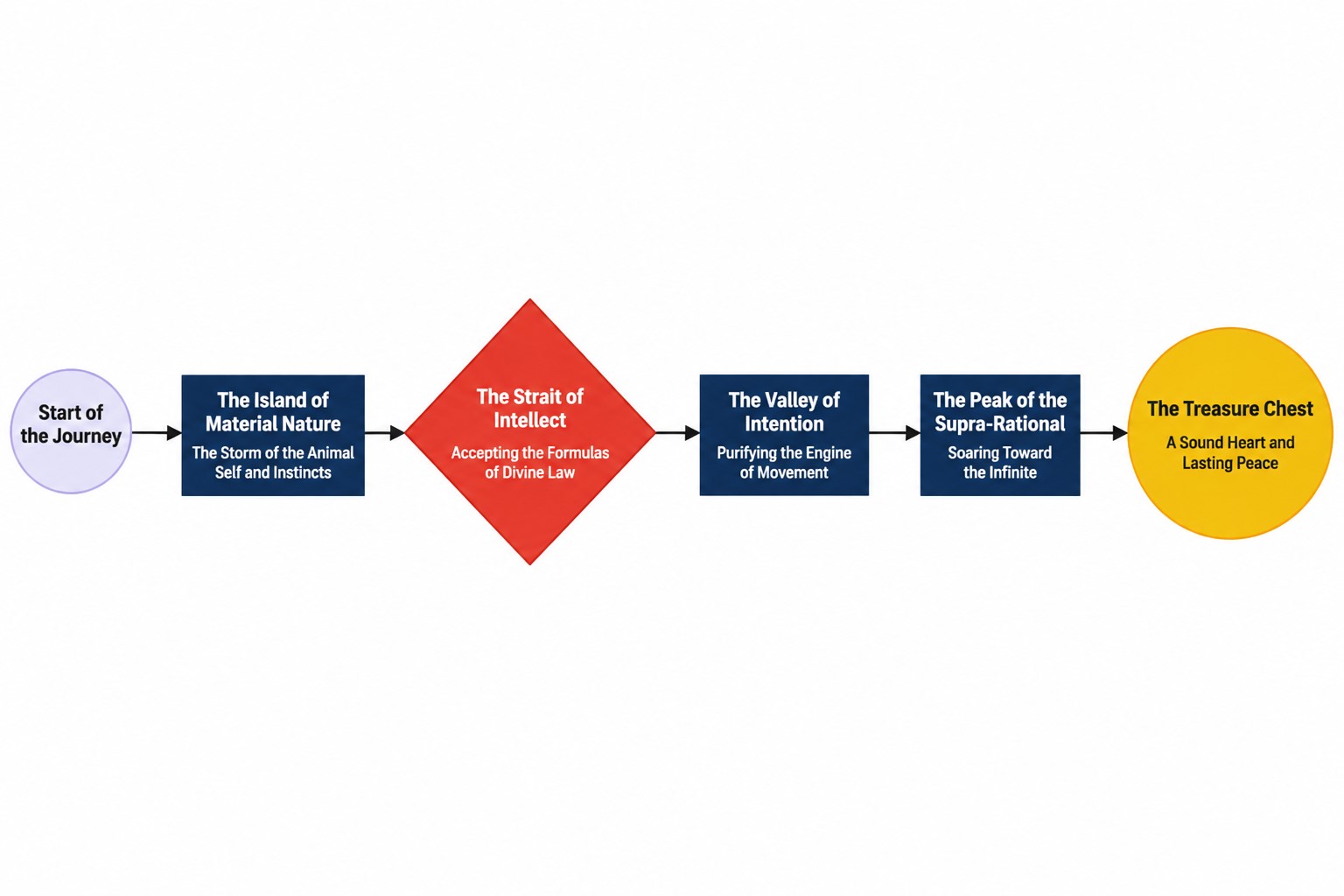
Imagine a traveler on the brink of an endless journey, looking at a map that provides the exact coordinates of their route and destination. If this traveler identifies solely with their carrier (the body) and their basic road-trip needs, the map will seem like a collection of cumbersome restrictions. But if they realize they are not merely the vehicle, but a pilot destined to navigate out of a limited atmosphere and into infinite space, the map’s true value is revealed. Religion is for humanity, and only by properly understanding this truth can we recognize its rightful place in our lives. Religion does not concern itself with our mere animalistic nature; rather, it speaks to our higher human dimension. We are beings whose lives extend far beyond biology, and religion serves as the “specialized manual” for the blossoming of our supra-rational dimension. The primary challenge in the modern encounter with religion stems from failing to recognize its true “audience”—ignoring the true self while obsessing over the false self.
Therefore, the starting point for any coherent discussion about faith is not religion itself, but understanding the foundational truth that religion is for humanity. If the audience is unknown, the message will inevitably be misunderstood. A major reason modern humanity feels distanced from the truth of religion is not because religion is intrinsically difficult, but because our self-image has become ambiguous. When a person identifies entirely with their material side, any guidance designed to elevate their higher dimension feels heavy, unnecessary, or even irritating. Conversely, when human truth is properly understood, it becomes evident that religion is not our rival, nor does it stand in opposition to our true desires. Rather, it protects our potential for perfection and accompanies us on the journey toward eternal life. Consequently, the core issue lies in explaining whom religion came for, what its ultimate goal is, how its rulings relate to human existential structure, and why this path culminates in the attainment of a “sound heart.”
Explaining Humanity’s Existential Position and Its Relation to the Source
The relationship between humanity and the Almighty is not conventional or contractual; it is strictly existential. Humans possess nothing independently; our entire existence, power, will, and perfection depend entirely upon the Source. From this perspective, divine ownership over humanity does not merely imply legislative authority or moral lordship, but our inherent, existential state of being owned. We truly belong to God, and no independent dimension of our being exists outside of this profound attachment. Consequently, any self-understanding that is detached from God is incomplete and ultimately false, as human reality is defined solely in relation to its Source.
This understanding of the human-Divine relationship also shapes our concept of perfection. Since human existence relies on God, our perfection can only be achieved by drawing nearer to that very Source. Human perfection, therefore, is not found merely in sharpening mental faculties, accumulating material wealth, or satisfying worldly desires; rather, it finds its true meaning in an existential journey toward the Almighty.
The truth of “La ilaha illallah” (There is no deity but Allah) is also comprehended at this level. This truth is not just a verbal rejection of false idols; it is the existential foundation of human life. It demands the rejection of any attachment that holds a person back from the Absolute Source, proving instead a comprehensive orientation toward the Truth. In this sense, “La ilaha illallah” is not simply a statement of faith, but the very basis of creation and the absolute rule of human perfection.
The phrase “Alhamdulillah” (All praise belongs to Allah) similarly finds its profound meaning within this system. To say that all praise belongs to God means that any perfection witnessed in humanity or the universe genuinely belongs to Him. Knowledge, power, will, life, and all forms of excellence fundamentally depend on Allah; whatever manifests in humanity is merely a reflection of His absolute perfection. As a result, the closer a person draws to their true reality, the more clearly they perceive their existential dependence, distancing themselves from the illusion of independence. Conversely, the more one neglects this truth, the deeper they sink into the delusions of self-sufficiency, ignorance, and ultimate misguidance.
From this, we can clearly grasp the intrinsic link between theology and self-knowledge. If the reality of the soul is a mirror of the Lord, knowing the soul reveals the path to knowing the Creator. When the soul is cleansed of impurities and worldly attachments, it gains the capacity to reflect this divine relationship. Self-knowledge is thus not a mere psychological exercise, but an existential necessity for gaining ma’rifa about the Truth. Until a person truly finds themselves, they cannot understand their relationship with the Source—and until that relationship is understood, religion will never appear in its true, radiant horizon.
Separating Existential Dimensions: The True Self vs. the Ego
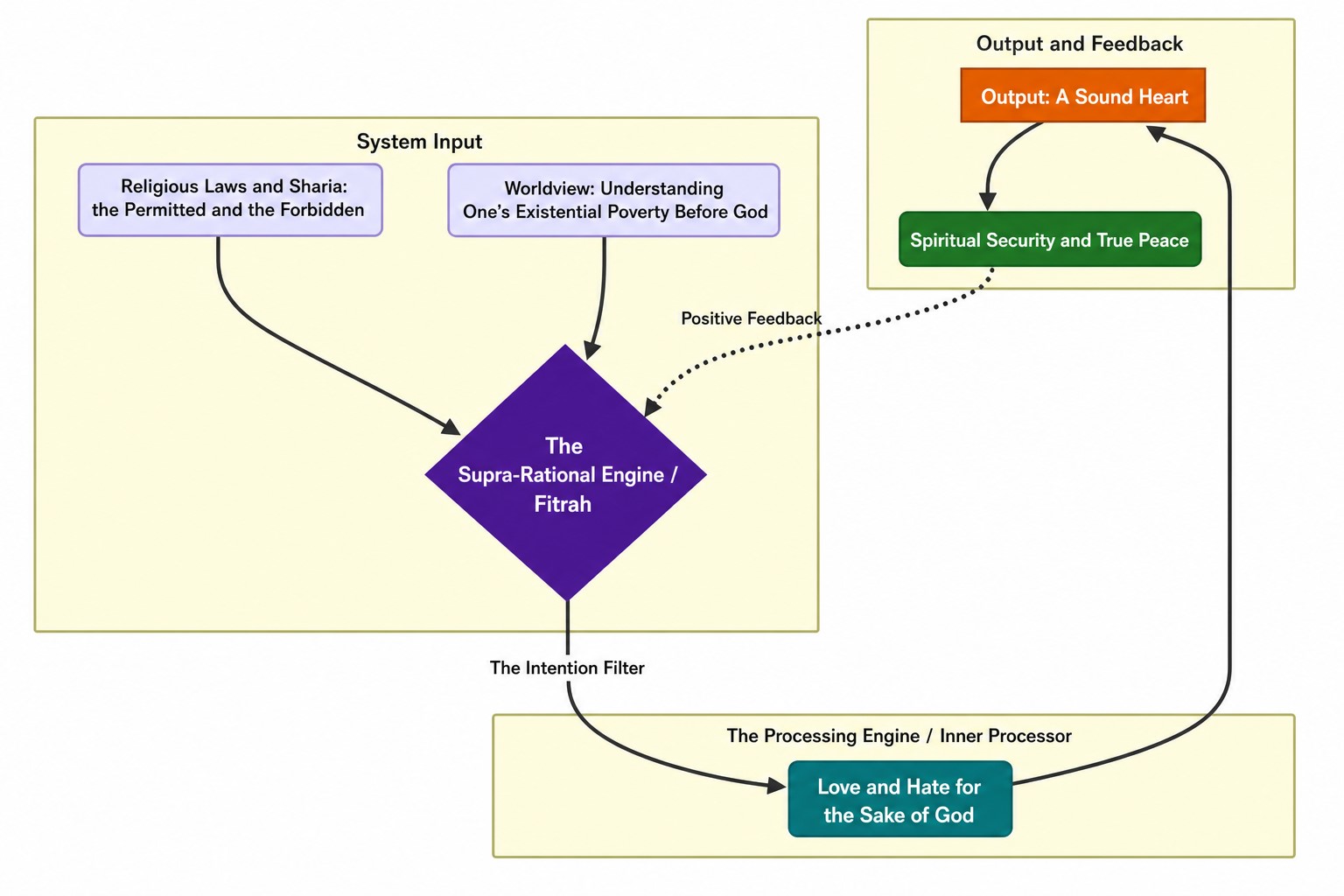
After establishing humanity’s existential relationship with the Source, we must clarify the internal structure of the human being, because religion was revealed in exact accordance with this structure. The human is not a one-dimensional being. We possess various levels and dimensions, beginning with the senses, imagination, and estimation, rising to the intellect, and extending even beyond that. What is crucial in this framework is that human truth is not confined to its lower existential levels. While our sensory, imaginal, and estimative dimensions are active parts of life, they do not constitute our ultimate reality. Even the intellect is not the end of the human journey. There exists a supra-rational level connected to fitrah, divine love, and the capacity to turn directly toward the Truth. Religion fundamentally targets this highest human dimension.
Therefore, distinguishing between the “true self” and the “ego” is essential for understanding religion. The ego, or the false self, is the dimension driven by pleasure, fear, attachment, comfort-seeking, habit, and worldly desires. It is the source of many of our internal pulls, resistances, and doubts. In stark contrast, the true self is the innate, divine dimension that sustains our connection with the Almighty and harbors the potential to achieve ultimate perfection. If a person fails to separate these two, their understanding of both themselves and religion becomes deeply flawed.
Much of the hardship experienced in a religious life stems directly from this failure to distinguish the two selves. When people speak of the pressures, hardships, and limitations of the religious path, we must ask: Which dimension is actually feeling the pressure? The answer is that hardships do not afflict the true self; they target the animalistic and lower dimensions of the human being. The part of us that suffers from deprivation, limitation, and spiritual discipline is not our divine truth, but the layer accustomed to the material world. Therefore, viewing religious laws as painful is usually the result of mistakenly identifying oneself entirely with the material layer. When the proper existential relationship is established, it becomes wonderfully clear that religion is not harming us; rather, it is training the ego in service of fitrah.
From this perspective, the mission of religion must be understood through the dynamic between the material nature and fitrah. Religion did not come to absolutely eradicate our material nature, but to harness it in the service of our fitrah. Left unchecked, the material nature becomes a breeding ground for doubt, neglect, worldly attachment, and spiritual regression. But when disciplined and trained, it transforms into a powerful vehicle for the ascension of our supra-rational dimension. This explains why so many spiritual deviations begin in the material nature. Objections and excuses often arise when a person uses their material attachments as the ultimate standard for right and wrong. When this happens, religion is viewed as a frustrating obstacle rather than a force that opens new, eternal horizons.
In this context, forgetting God inevitably leads to forgetting oneself. When a person loses sight of the Source of their existence, they sever the connection to their own truth. Consequently, all their worldly efforts—no matter how massive or seemingly successful—ultimately work to their detriment, because they are rooted in a false self-understanding. Conversely, finding oneself means discovering the true path of life. Such a person recognizes that their primary task is not merely managing their earthly affairs, but preserving and nurturing a soul created to journey toward the Truth.

Defining Religion in Relation to Human Truth
Because religion is for humanity, its definition becomes crystal clear once we comprehend the human existential structure. In this light, religion is not a mere collection of rituals, ceremonies, or disjointed historical facts; it is a specialized, cohesive system designed to guide humanity toward perfection. If a human is a multi-dimensional being whose truth lies in their innate (fitri), divine dimension, then religion must be the exact set of laws that cultivates this dimension, clears away obstacles, and sustains its connection with the Source. Religion is thus an absolute necessity for human life, not an external imposition. Just as every creature requires laws suited to its specific biological structure to thrive, humans require divine law to achieve authentic bliss and perfection.
Viewed this way, religion plays a deeply supportive role. It does not stand in opposition to us; it faithfully accompanies us on our eternal journey. Its duty is to harmonize our scattered inner faculties, rescue us from dispersion, and propel us toward our true existential destiny. Without religion, a person’s inner faculties not only fail to unite, but actively war against one another. The ego pulls in one direction, estimation and imagination hijack the mind, and the intellect and fitrah are pushed to the margins. Religion was revealed specifically to cure this internal chaos and establish profound existential harmony within.
This also clarifies religion’s primary mission. Humans possess an unquenchable thirst for the infinite. No limited, finite worldly thing can ever truly satisfy us. If this desire for the infinite is not channeled correctly, it shatters into a million scattered, false desires. But when placed on the right path, it points like a compass toward the Absolute Truth. Religion’s task is to make this very capacity blossom. “La ilaha illallah” functions here as the ultimate educational rule: A person must bypass whatever has wrongfully claimed the center of their heart instead of God, allowing their desire for the infinite to finally connect with its true, eternal goal.
Consequently, pure religion is one that is never used as a tool to attain anything other than God. If faith is leveraged for worldly interests, fame, status, power, or ego satisfaction, it has entirely deviated from its purpose. The purity of religion requires a person to be free of doubt, ego-worship, and duality, ensuring their compass is set solely on nearness to the Truth. This sincerity elevates religion from a formal set of rules into a transformative, guiding reality.
The Philosophy of Rulings: Training Humans to Become Similar to the Truth
Religious rulings cannot be accurately understood in isolation from this holistic view of humanity and our ultimate destination. If religion was sent to actualize human truth, its rulings are the practical tools for that actualization. Halal (permitted) and Haram (forbidden) are not arbitrary or conventional boundaries; they are intimately tied to our existential structure and our capacity to manifest divine names. Something is made Halal or Haram specifically because certain actions place us on the path of becoming like the Almighty, while others block or reverse that spiritual momentum. Therefore, religious rulings must always be viewed through the lens of spiritual training and the manifestation of divine attributes.
In this system, the true human asset is measured by how deeply one acquires divine names and attributes, not by what one controls in the material world. Rulings are the regulating mechanisms of this sacred process. If an action tethers a person to their lower existential level, roots them in their ego, or thickens the veil between them and the Truth, that action sabotages their journey. Conversely, if an action directs the heart toward the Truth, severs attachments to the material world, and aligns one’s intention with divine nearness, that action transforms into a pure existential asset.
Here, the concept of intention (Niyyah) takes on monumental importance. Intention is the precise element that elevates an action from a superficial physical movement into a vehicle for divine nearness. Two actions may appear identical on the outside, but only the one performed with a divine intention affects a person’s existential structure. Intention turns mere action into spiritual nourishment for the heart. For this reason, not all activities equally result in gaining existential assets. Actions that remain trapped at the level of the material nature never reach the heart. However, those exact same actions, when paired with a divine intention, become lasting human assets.
Rulings, therefore, should never be viewed merely as a checklist of binding duties; they are the tools for training our inner dimensions. Ritual prayer (Salah) exists for the remembrance of God—meaning it redirects the heart away from distraction and worldly neglect, returning it to the Source. Yet, this also highlights that merely performing the outward motions of worship is not the true criterion for religiosity. A person might perform an act of worship, but without true spiritual direction, authentic faith has not been realized. Religion only truly manifests when a person’s loves, hates, friendships, enmities, and fundamental inclinations revolve entirely around the divine axis. If someone meticulously observes religious forms but their loves and hates remain untouched by divine principles, they have not yet tasted the truth of religion.
At this stage, the station of “submission” (Taslim) reveals its exact meaning. In this framework, submission is not blind, weak passivity; it is the natural result of deeply knowing the Mentor (Rabb). When a person recognizes God as their Lord and Mentor, implicitly trusting His supreme wisdom, following His law becomes an act of pure rationality. Just as an elite athlete trusts their coach’s rigorous program to reach peak performance, a believer submits to divine laws to attain perfection. This submission is the very root of faith; without excellent submission, faith can never stabilize. The deeper the submission, the more organized, rapid, and beautiful the existential movement toward the Truth will be.
Religion, Love, and Turning Duty into Life
If religious rulings are understood on a deeper level, the intrinsic connection between faith and love is revealed. Human truth is not merely a calculating intellect; love and devotion to the Almighty reside at the very core of our being. Because of this, the deeper religion penetrates the soul, the sweeter, more comforting, and more vibrant it becomes. Conversely, if religion remains trapped as dry forms or burdensome obligations, it has not yet reached our core dimension. The ultimate goal of religion is to train us around the axis of “La ilaha illallah,” and this training peaks when our relationship with God transforms from a heavy duty into passionate devotion.
This is where worship takes on an entirely new dimension. At the lower levels, worship is merely fulfilling an obligation; at the higher levels, it erupts into eagerness and joy. The virtue of loving worship originates here. A true believer in the state of worship feels they are returning to the very lifeblood of their existence. This phenomenon explains a believer’s profound attachment to the mosque or their fearless eagerness for striving in the way of God (jihad)—situations that seem difficult or terrifying to others become intimately familiar and beloved to someone deeply trained in faith. Ultimately, the religious journey must reach a point where duty is merely the outward manifestation of inner love, rather than a heavy burden imposed upon the material nature.
This nexus between religion and love explains why faith becomes an inexhaustible source of power, pleasure, and peace. When a person aligns with their existential truth, they do not fall apart under pressure; they become deeply unified. Their scattered inner faculties rally around a single divine center, generating immense inner strength. This is the strength that manifests in authentic religious experiences as unshakable peace, happiness, endurance, and the capacity to navigate severe crises. Religion, then, is not just a behavior modification system, but a divine force meant to completely rearrange the human interior.
The Sound Heart: The True Human Asset
As this journey unfolds, the attainment of a sound heart emerges as the ultimate outcome of true religiosity. Knowing that humans are destined for eternal life, we must ask: What part of us survives this worldly life to form our true, eternal asset? In this system, the answer is definitive: not wealth, not children, not social status, and not even the mere accumulation of outward deeds. The only authentic, lasting asset is a sound heart. A sound heart is one in which absolutely nothing other than God has settled; it is a heart meticulously cleansed of any attachments that might rival the Truth, rendering it a pure vessel for divine love.
This heart is forged through continuous, deliberate choices, pure intentions, acts of obedience, and divine orientations. True human investment must be poured into this exact heart. If our earthly activities do not become spiritual food for the heart—even if they yield massive worldly success—they fail to stabilize anything at the existential level. But when an action is infused with love, devotion, and presence of heart, it transforms into an eternal human asset. This clarifies the relationship between action and asset: An action only becomes an asset when it successfully takes root in the heart and directs it toward the Divine.
The unbreakable link between a sound heart and profound peace is also evident here. In this worldview, chronic anxiety, lingering sorrow, spiritual insecurity, and inner turmoil are glaring symptoms of a structural disorder within the heart. A heart that leans on anything other than God will inevitably experience fear and anxiety, perfectly proportionate to its attachment to those unstable, worldly things. In contrast, a heart organized entirely around the Truth achieves absolute stability, because it is tethered to the One who knows no decay, absence, or instability. Peace and happiness are therefore not fleeting psychological moods; they are the existential vital signs of a healthy heart. We can confidently conclude that spiritual security is one of the most critical indicators of authentic religiosity.
Religion, Fear, and Spiritual Security
One of the most devastating consequences of abandoning religion is the proliferation of fear in a person. Fear, in this context, does not merely mean an instinctive biological reaction to physical danger; it refers to a deep, structural insecurity of the soul. It is the agonizing state of a person who has lost their existential anchor, leaving them perpetually restless about the future, the past, others, and even themselves. This existential fear breeds a host of moral vices: envy, arrogance, despair, aggression, oversensitivity, and spiritual withdrawal. A fearful soul, desperately trying to protect its fragile, shaky ego, inevitably resorts to either aggression or passivity.
Consequently, separation from religion is a literal separation from security, because religion is what connects us to our true, unshakable support. The weaker this divine connection, the wider the battlefield becomes for Satan’s attacks. A person devoid of religious certainty lacks stability not only during major life crises but even in the mundane flow of daily life. They are easily swept away by inner turmoil, misjudgments, and inner collapse. In contrast, by instilling profound spiritual security, religion grants us the power to conquer obstacles and transcend tragedies. This security goes beyond the individual; it radiates outward with massive social implications. Wherever authentic religious structure flourishes within a family or society, human relations naturally distance themselves from violence, crime, and chaos, precisely because most social disorders are merely outward projections of humanity’s inner insecurity.
Spiritual peace can therefore be used as a definitive metric to measure the actual presence of faith within a person. A religion that fails to produce inner security is either trapped at the level of blind imitation or stalled in the realm of theoretical rationality, having never penetrated the realm of the heart and love. The more powerfully God reigns within a person’s soul, the more rapidly their false fears collapse, distancing them from the terrifying instability that comes from relying on the material world.
Facing Problems and the Victory of Fitrah Over the Material Nature
Because hardships primarily strike the material nature of the human being, and because religion actively strengthens the innate part, a religious person does not merely “endure” inevitable suffering. They possess the ability to rise above the miserable level of “doing their duty” and ascend to a station where they walk the hardest paths with absolute love. The difference between these two levels is foundational. At the lower level, a person is still wrestling with their ego, bitterly bargaining over the rules and the pain. But at the higher level, the heart is perfectly aligned with the Truth, giving hardship an entirely new meaning.
This is exactly why worldly tragedies can be given a profoundly human, and even aesthetic, interpretation by the faithful. When the true self conquers the false self, suffering ceases to be a mere experience of brokenness and loss; it transforms into a sacred arena where truth manifests. The pinnacle of this reality is witnessed when the most devastating losses and intense pressures produce no complaints, but instead grant the sufferer a breathtaking vision of divine beauty. This elevated response to tragedy is not born of empty slogans or emotional hype; it is the direct result of establishing a new existential relationship within—a relationship where the Truth absolutely rules the heart, and the material nature is quietly marginalized. In this state, religion is not the cause of imposed suffering, but the divine mechanism that gives meaning to the pain, allowing the believer to soar far beyond the material level of tragedy.
The Fitrah-Oriented Believer and the Ego-Oriented Believer
This brings us to another vital distinction: the difference between fitrah-oriented religiosity and ego-based religiosity. A “naturalist believer” may meticulously observe religious forms, display an outward affection for sacred things, and even act vigorously in the physical world, but their core spiritual direction has never transcended their material nature. As a result, their faith remains highly vulnerable to the spiritual pests of narcissism, hypocrisy, fanaticism, and a shallow obsession with appearances. In stark contrast, a “fitrah-oriented believer” is someone whose fitrah has been deeply penetrated by the truth of religion. For them, religious forms are not tools used to stabilize their ego, but transparent windows looking directly upon the Truth.
This profound distinction directly dictates one’s lifestyle. A truly faithful lifestyle is rooted in a healthy pessimism toward one’s own ego and a generous optimism toward others. A fitrah-oriented believer never becomes intoxicated by their own worship or good deeds; they actively flee from religious narcissism, maintaining a constant state of seeking forgiveness even for their best actions. They intimately understand the vast, serious gap between what they are and what they should be. This humility does not arise from a lack of self-esteem, but from a piercing awareness of their relationship to Absolute Perfection. Conversely, whenever religiosity breeds arrogance, entitlement, or a superiority complex, it is a guaranteed sign that the faith has become permanently stalled at the ego level.
The World, the Hereafter, and the Ultimate Horizon of Life
All of these philosophical threads ultimately weave together at the horizon of the relationship between this world and the Hereafter. If this world is the farm of the Hereafter, it means our earthly life is not the ultimate destination, but a temporary, critical arena for cultivating eternal assets. The fleeting brevity of this world, when contrasted with the vast continuation of the intermediate realm (Barzakh) and the eternal Hereafter, demands that we value our lives exclusively through this eternal horizon. In this divine system, what we are actually building in this world is our human existential truth, not a temporary status. Consequently, every single component of religion—from ma’rifa and faith to practical rulings, ethics, and worship—serves one unified purpose: to construct the very heart with which we will meet the Lord, ensuring that absolutely nothing other than Him resides within it.
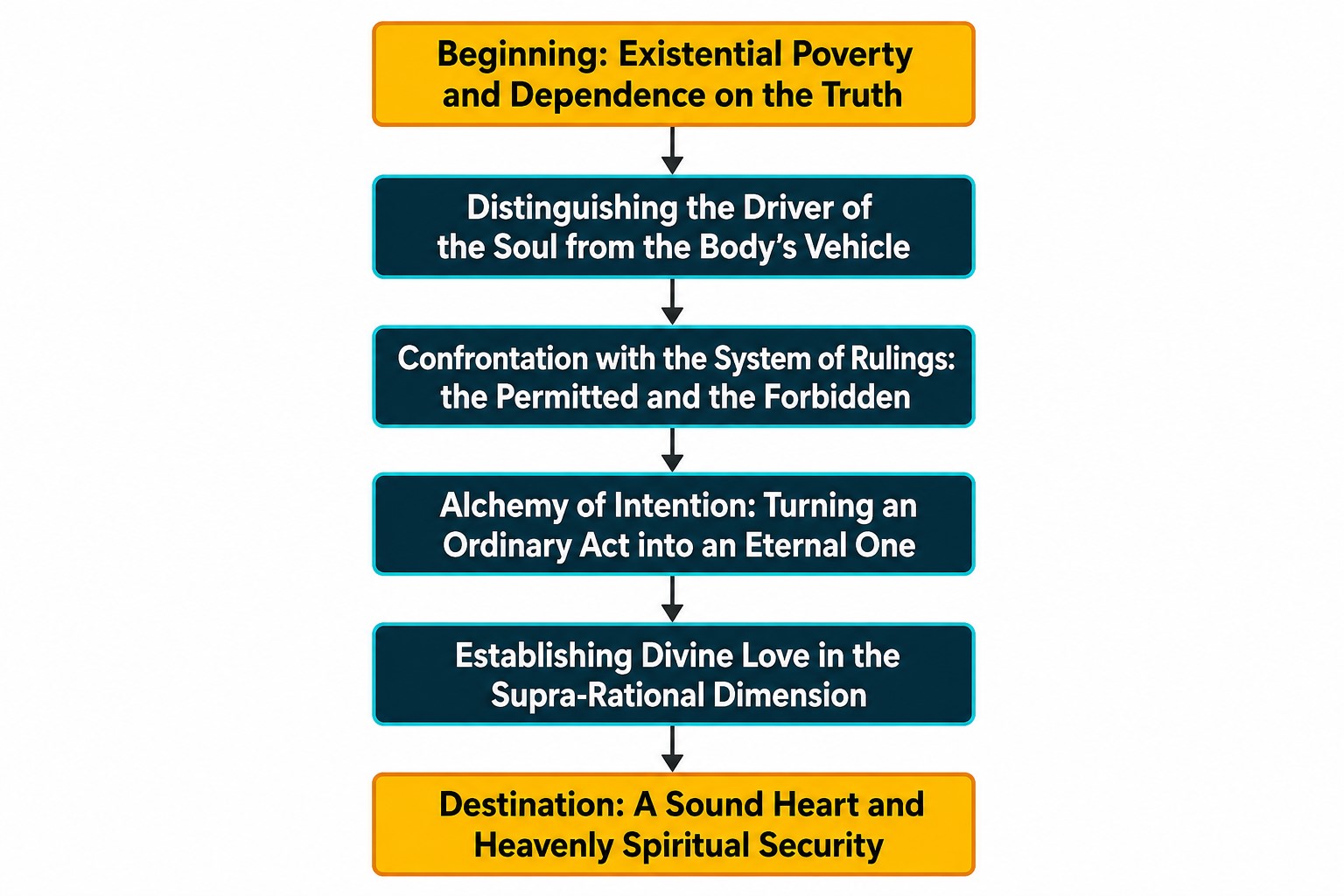
Therefore, when we declare that religion is for humanity, we are not speaking of someone who merely needs a moral code to regulate their daily life. We are speaking of beings who are existentially designed for eternal life, and religion is the exclusive roadmap for that exact existence. Once this truth is fully embraced, the proper place of every key concept snaps into focus: Self-knowledge becomes an absolute necessity, theology finds its true meaning through the soul, rulings are revealed as educational tools, love and worship take their rightful place at the center of faith, spiritual security becomes the ultimate standard of measurement, and a sound heart is recognized as the only lasting asset we will ever own.
Conclusion
The most fundamental requirement for understanding faith is the realization that religion is for humanity. As long as a person defines themselves by their material nature, fleeting desires, earthly fears, and biological needs, religion will always feel like a suffocating web of restrictions and conflicts. But once it becomes clear that true human truth resides in our innate, divine, and supra-rational dimension, religion reveals itself as a perfectly rational and profoundly necessary system. It is a divine framework established to preserve our connection to the Source, harmonize our inner faculties, discipline our material nature in service of our fitrah, and safely deliver us to the shores of a sound heart.
In this ultimate horizon, “La ilaha illallah” stands as the fundamental law of human existence, religious rulings become the tools for becoming like the Truth, and pure intention serves as the alchemy that turns action into an asset. Unshakable peace and security become the undeniable proof of religion’s active presence in the soul, and the sound heart stands as the glorious, ultimate destination of this lifelong journey. Ultimately, religion is not an arbitrary burden added to human life; rather, it is the fundamental prerequisite for our true existential blossoming. The closer a person draws to this magnificent truth, the further they distance themselves from their false self and the closer they arrive at their true self. And this very drawing near is the absolute, true meaning of life, perfection, and eternal salvation.