
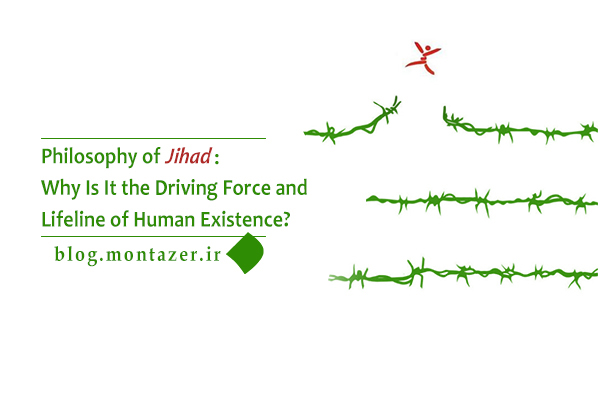
Walking the Path of Truth: From Individual Uprising to Global Responsibility
Imagine a complex system designed so that its driving engine operates only through friction and confrontation with opposing forces. If placed in a vacuum without any resistance to challenge it, the system not only fails to grow but also suffers complete erosion and stagnation. This principle reflects a fundamental reality for human beings as creatures endowed with free will. When placed in an isolated environment, devoid of existential challenges, a person drifts away from their true essence to the exact degree that they cease to strive. Human perfection depends entirely on leaving static comfort zones and entering dynamic, high-stakes arenas.
This article examines the existential structure of humanity, explaining why stagnation and passivity equate to existential collapse for anyone seeking to transcend the animalistic realm and reach divine realms—ultimately revealing the true philosophy of Jihad.
Jihad as the Ultimate Source of Recreation and Vitality
Conventionally, recreation is defined as escaping hardship to enter a state of relaxation. However, within the epistemological framework of the Prophetic tradition, the concept of recreation fundamentally changes. The Holy Prophet (Peace be upon him and his family) stated, “The recreation of my Ummah is Jihad in the way of Allah” [1]. In this view, true vitality is not found in passivity, but rather in high-stakes activism and actively confronting the true enemy.
The logic behind this proposition is that the human soul is inherently intertwined with a sense of becoming and ultimate purpose. A person lacking profound concerns and transcendent ideals inevitably becomes trapped in a web of daily routine and depression. Anyone who has not internalized the spirit of Jihad not only fails to achieve true peace but also suffers from a profound sense of uselessness due to their unfulfilled existential potential. Conversely, a warrior standing on the battlefield against falsehood overflows with vigor, drawing upon an infinite source of power. This joy is not a fleeting thrill, but the direct result of aligning one’s individual will with the life-giving will of the Divine. Real-world evidence, such as the uplifting humor shared by warriors at the height of battle, proves that engaging with hardship does not cause lethargy; instead, it expands the soul and cultivates profound happiness.
The Hierarchy of Uprising and Jihad in the Quranic Value System
In verse 24 of Surah At-Tawbah, God provides a criterion for distinguishing the true believer from the fasiq. According to this framework, three beloveds must sit at the absolute pinnacle of human desire: Allah, the Ahl al-Bayt (Peace be upon them), and Jihad.
This prioritization is not a mere abstract concept, but rather a powerful engine for spiritual propulsion. If wealth, housing, commerce, and family attachments outweigh these three beloveds, one’s developmental journey comes to a halt. In this state, a person falls into fisq, ultimately leading to the deprivation of divine guidance. Within this framework, therefore, the philosophy of Jihad reveals it is not a marginal activity but a fundamental prerequisite for life. A person who refuses to rise up is, in reality, degrading their own soul. Through commands such as rising up for Allah—whether in pairs or individually [2]—the Holy Quran draws the believer out of the realm of pure individualism and summons them into the arena of social uprising.

A Structural Analysis of Fear and Jihad on the Front of Truth
Fear is one of the greatest obstacles on the path of human growth. It is the direct result of focusing on a power other than God. True faith, however, completely dismantles the logic of fear. In verse 173 of Surah Al Imran, when a massive enemy army threatens the believers, their reaction is not retreat, but rather an increase in faith. This is an existential law: The threat of an enemy ultimately stabilizes and strengthens the believer’s faith.
Imam Khomeini emphasized this exact logic, stating that true religiosity cannot coexist with the fear of superpowers. Fear simply exposes a lack of knowledge regarding the Unseen. The believing human, trusting deeply in the truth of La ilaha illallah, leaves no room for global arrogance to project its power. The spirit of Jihad that placed the sword in the hands of the Prophet and Imam Ali (Peace be upon them) is precisely this fearlessness born of absolute certainty. This spirit directly contradicts the empty claims that label Jihad as inherently violent while advocating for a one-sided, unconditional affection. True affection, when devoid of disassociation from the enemies of truth, is inherently flawed and non-divine.
Jihad and the Structure of Social Interactions
The scope of this movement encompasses every sphere of human existence. Today, arrogant global powers utilize media and satellite technology to manipulate the mindset of the general public. Under these circumstances, inactivity is tantamount to aligning with the Front of Falsehood. A narration from Imam Sadiq (Peace be upon him), which states that a Shia who imparts Islamic teachings to others is superior to a thousand mere worshippers, highlights this exact social function [3].
A person focused solely on worship is confined to their own individual elevation, whereas one who prioritizes cultural Jihad extends their existential capacity to uplift others. In the contemporary world, this Jihad is not necessarily military. Sometimes, Jihad takes place in the economic sphere; other times, it occurs in the cultural sphere by explaining and narrating the truth, or through a zealous, active presence in cyberspace. The critical point is that producing a positive, outward impact on others is mandatory on this path. By emphasizing the mutual enjoining of truth [4], the Holy Quran demonstrates that a believer’s ultimate responsibility is not self-isolation, but rather a continuous invitation to the truth.
The Minimum Level of Activism on the Path of Jihad
Even when individuals lack the means to take external action, they must not succumb to passivity and comfort. The absolute minimum level of participation in this existential arena is experiencing heartfelt sorrow over one’s inability to act. A person who cannot physically fight or actively engage must never remain indifferent to the Front of Truth. Indifference is the ultimate sign that the spirit of Jihad has died within.
The believer knows that this world is an abode of affliction, and that hardships and tribulations are integral to accumulating spiritual asset for the Hereafter. The Ahl al-Bayt (Peace be upon them) endured the most severe afflictions, yet these hardships never diminished their greatness; rather, in the profound words of Lady Zainab (Peace be upon her) on the evening of Ashura, she saw nothing but beauty in them. Thus, according to the believer’s logic, the hardships born of Jihad are not tragic; they are an adornment and a powerful catalyst for existential elevation.
The Connection Between Love and Jihad
The primary driving force of a true human being is love. A religious person devoid of both love and hate is akin to a lifeless corpse. Anyone who has not cultivated these twin pillars of love and hate has not yet established a deep, intimate connection with the Unseen. When love for God and the Ahl al-Bayt (Peace be upon them) truly settle in a person, it logically produces an aversion toward the enemies of these beloveds. The definitive outcome of this aversion is engaging in Jihad.
A person who remains indifferent to the destiny of truth actually harbors no real love. They might outwardly appear to be a successful doctor, cleric, or engineer, but because they lack a true existential connection to the Unseen, the Quran classifies them as a fasiq. Maintaining a zealous presence in cyberspace serves as a modern-day manifestation of this love. According to Islamic narrations, it is a profound act of devotion to remember God when most people around one are forgetful. This effort is considered as honorable and greatly rewarded as the ultimate sacrifice made by a martyr dying for God. This profound resemblance indicates that across any platform—whether military, cultural, economic, or digital—a believer must stand firmly alongside God and the Imam of their time.
Evading Responsibility: The Primary Obstacle to Growth
Based on these established criteria, fleeing the front lines is not merely a tactical error, but a complete moral failure. By evading Jihad, individuals deprive themselves of genuine joy and vitality. This evasion typically stems from the fear of a slumping market, losing a home, or parting with family—the very worldly attachments listed in verse 24 of Surah At-Tawbah as the primary barriers to divine guidance.
Therefore, to lead a truly balanced human life, one must embrace the philosophy of Jihad, ensuring that this multidimensional struggle becomes the absolute priority of one’s life. This struggle is simultaneously internal, battling against fear and worldly attachments, and external, fighting against oppression and falsehood. Regardless of their social standing or position, a person must produce a positive impact and leverage this movement to reach the ultimate summit outlined by the Quran: the expansive Heaven. This is the very same century-long journey that some enlightened souls traversed in a single night, having profoundly realized that truth manifests solely in Jihad.
References
[1]. Shaykh al-Tusi, Tahdhib al-Ahkam, vol. 6, p. 122, hadith 5.
[2]. Quran, 34:46
[3]. “A scholar whose knowledge is benefited by others is superior to seventy thousand worshippers.” (al-Kulaynī, Al-Kāfī, vol. 1, p. 33, hadith 3; al-Majlisī, Biḥār al-Anwār, vol. 2, p. 17, hadith 33)
[4]. Quran, 103:3
Comments and questions
Ask a question or share your experience with this lesson.
After signing in and enrolling, you can join the discussion.
Be the first to ask a question about this lesson.