
What Is As- Sirat, and How Do We Cross It?
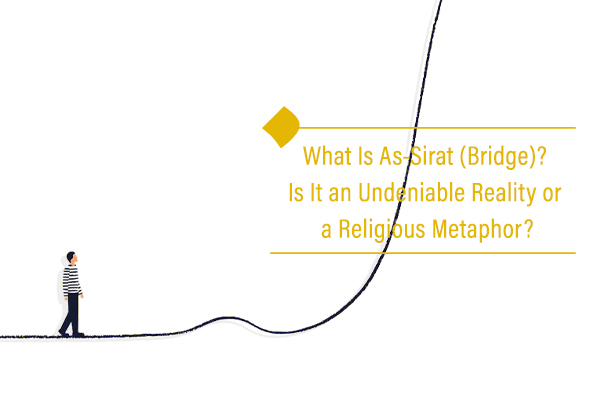
When we are asked, “What is As-Sirat?” we often imagine a pathway thinner than a strand of hair and sharper than a sword—one that stretches over Hell, and one which all human beings, even the prophets, must cross. Some traverse it with the speed of light without feeling any heat or discomfort; others move more slowly, some with hesitation and uncertainty, and some fall.
Yet we rarely ask what the As-Sirat truly means. What kind of bridge is it? Who constructs it? Where is it located, and what determines the speed at which each person crosses—would they fall?
The answers to these questions lie in the purity of one’s heart. Our pace and manner of crossing As- Sirat on the Day of Judgment are nothing but the outcome of our deeds and choices in this world. A purer heart means an easier passage. But how is the health of the heart measured?
To understand this more clearly, we can turn to the analogy between the fetal stage and worldly life. In the mother’s womb, everything the baby needs for life in this world gradually takes shape. In fact, the developmental path of the fetus is its own Sirat: If this path is taken correctly, the baby enters the world with a healthy body, and if any defect occurs in this process, its effects will appear in the next stage of life. In other words, the fetus is both the traveler of the path and the one who shapes it.
Our worldly life follows the very same principle. The world is like a womb, and within it we are constructing our own Sirat. Our heart is our Sirat, and we build it—brick by brick—through our beliefs, relationships, major and minor choices, and all sensory inputs such as what we look at, how we act, what we eat and drink, how we sleep and wake, and what we hear and see. As a result, As-Sirat must pass through Hell in order to lead us to Heaven.
But now a more important question arises: If the Sirat is our very self—our heart—then where is the Hell we must cross? And what does the Heaven that awaits us truly mean?
The Hell through which the Sirat passes is the very assault and temptation of Satan and the ego—the challenges we encounter in this world. By striving against these challenges, we can return to the heaven of our fitrah and attain the divine truth within us. Each time we resist temptation, we secure and illuminate a part of our Sirat; and each time we yield, we narrow and darken the path. Thus, the reality of the Sirat exists simultaneously in this world and in the hereafter.
What Is As-Sirat?
To clarify the concept further, let us return to the example of the newborn. When a child is born, we do not ask, “Can you drink milk? Can you see me? Can you hear my voice? Do you have hands and feet? Are the features of your face in the right place?”
The child’s health or illness is not revealed through questioning. Rather, the newborn’s appearance and reactions testify to their condition—how they passed through the hardships and darkness of the womb, and whether they received the care and nourishment they needed.
Every physical characteristic of the newborn, whether sound or impaired, is the outcome of the very path they traveled in the womb. The developmental journey of the fetus is its Sirat; if this path is formed correctly, a healthy birth is ensured. But if a defect occurs along this journey, the child will inevitably face difficulties in the world.
In the same way, the developmental path of our worldly life is also the path through which we construct our Sirat. As- Sirat is not merely a bridge in the Hereafter that we suddenly encounter after death; it is a path we are already walking in this world, building it with every choice we make. The Sirat is not something outside of us—it exists within us.
Therefore, the question “What is As-Sirat?” has a clear answer: As- Sirat is the very path of human life—the path through which our heart, soul, and fitrah are shaped, and through which our wellness or illness will be revealed in the Hereafter.
Where Is the Hell of the Sirat?
It is sometimes mistakenly said that As- Sirat passes over Hell; however, this is not the case. The Sirat passes through Hell. As we have explained, the Sirat exists within the human being; therefore, the Hell through which one must guide their Sirat is also within the human being.
The Sirat is the way of life we are currently living, a path that passes through the “Hell” of our own ego. Human ego includes an excessive and uncontrolled inclination toward the perfections of the lower dimensions of the soul: material, vegetative, animalistic, and even intellective. These tendencies constitute the inner Hell through which our Sirat must pass.
We live within a vast Hell made up of whims, attractions, attachments, and countless major and minor inclinations that surround and engulf our entire being. Each person has their own personal Hell— their own particular ego, their own whims, desires, and unique weaknesses. People’s vulnerabilities manifest uniquely: some contend with overindulgence or an obsession with academic recognition, while others are challenged by wealth, beauty, or the powerful temptations of leadership and authority. In any case, the human being must walk a straight Sirat through all this turmoil and these hellish inclinations—pushing them back from left and right, from ahead and behind—until they gain purity of the heart, which is their heavenly fitrah.
The truth is that these desires possess great power, yet not greater than the power of the human heart. The strength of these desires is inversely proportional to the strength of the heart. In other words, the more a person refuses the various demands of the lower parts of their being, the more they unconsciously weaken those desires and strengthen the human dimension within themselves. The greater the power of our fitrah or divine dimension, the healthier our soul is. Consequently, our Sirat becomes straighter, smoother, and faster. In such a state, as we preserved the purity of our heart in this world, we will safely cross the Sirat—which lies within the Hell of the Hereafter—as well. However, if in this world we fall into sadness, anger, resentment, backbiting, jealousy, slander, or conflict with others at the slightest provocation, then we have already fallen into the Hell of our own ego. Every time we become entangled in a moral vice or a negative trait, we narrow and darken our Sirat at that very point and draw closer to falling.
Perhaps now we can better understand what As- Sirat is and what the Hell of As- Sirat truly means. The straight path is the path toward attaining a sound heart and reflecting the names and attributes of God. One of its most essential features is establishing balance among the various faculties of the soul—such as imagination, sense perception, estimation, and intellect. Creating balance among them is so critical that if any one of these faculties is overfed or neglected, the health of the others is endangered as well, and none of them can function properly. For example, when the estimative faculty is excessively strengthened and given too much freedom, a person becomes fearful of war and jihad. To clarify further what As- Sirat is and what threatens one’s passage across it, we can look at another example—excess in the intellective faculty. An overload of information can be harmful to the intellective faculty. Such a person activates their intellect excessively while neglecting other faculties, including the divine faculty responsible for their inner peace and vitality. As a result, they experience less tranquility and well-being, lose the power to act, and ultimately cannot cross the Sirat safely.
In this article, we came to see that the question “What is As- Sirat?” is not merely a question about the Hereafter, but a reflection on our present life.
-The Sirat is not an external bridge on the Day of Judgment; it is the purity of our heart and the way of life we build in this world.
-The world is like a womb, and with every choice we make, we construct our Sirat.
-The Hell of the Sirat is not something outside of us; it is our own inner desires and temptations through which we must pass.
-A safe passage across the Sirat depends on how closely we reflect the names and attributes of God and on maintaining balance among our inner faculties.
Therefore, the reality of As- Sirat is nothing other than our own being, and every look, action, behavior, and decision—large or small—is a brick in the construction of our Sirat. If we build our Sirat soundly and brightly today, then tomorrow, on the Day of Judgment, crossing it will be easy.
In the next articles, we will explore the role of Satan on this path and the key to crossing the Sirat safely and powerfully.