
From Love to Servitude: An Ontological Analysis of the Boundary Between Truth and Falsehood in a Divine Lifestyle
In daily life, many human choices seem simple and ordinary: choosing a field of study, socializing, consuming, hosting a family event, or communicating with a spouse and children. These decisions usually appear scattered and minor, but closer inspection reveals they are rooted in a broader orientation. Every micro-choice stems from a macro-direction. This direction dictates which standard a person prioritizes at the moment of decision, what they value, and whose authority they follow. The main issue begins here: Are our behaviors regulated merely by desire, habit, profit, and custom, or do they find meaning in relation to a higher principle?
This question becomes more serious when two people in similar situations reach completely opposite outcomes. Both might strive, worship, study, or engage in social activities, but one remains steadfast on the path of truth while the other breaks down at critical junctures. Outward actions alone cannot explain this difference. The core issue lies in the type of human connection to the truth, the place of love in the soul, and the relationship with Wilayah (Divine Orientation/Guardianship). From this perspective, human life is an interconnected structure of ma’rifa, love, choice, and obedience, rather than a collection of isolated actions.
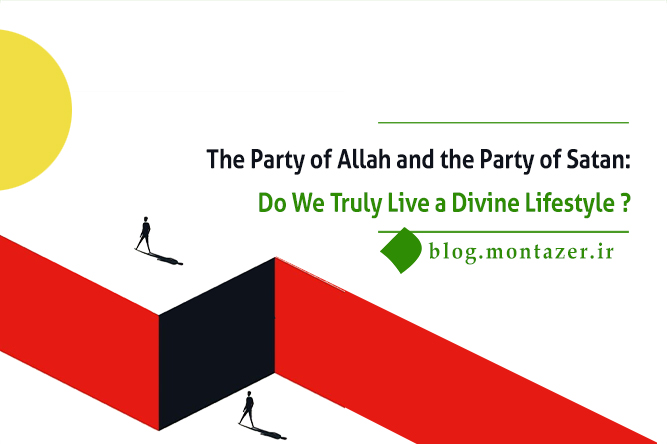
Therefore, discussing the Party of Allah and the Party of Satan is not merely a doctrinal or moral categorization. It represents an analysis of two directional systems of life. A person either aligns with the truth and regulates all aspects of life accordingly, or enters another orbit that lacks true purpose despite its outward adornment. The question is where a person’s life model begins, where it ends, and what relationship it establishes with the truth.
Wilayah: The Starting Point in a Divine Lifestyle
The most fundamental principle in organizing a correct life is clarifying one’s relationship with Wilayah. A person is on the right path when their access to knowledge and the regulation of their individual and social life pass through Wilayah. In this view, Wilayah is the directing center that determines which thoughts, behaviors, and choices align with the truth.
If this axis is removed, human actions will lack ultimate coherence, no matter how abundant or diverse they are. Without this center, knowledge can become mere data accumulation, social activity is reduced to fame or mere participation, and even religion downgrades to actions disconnected from the ultimate goal. The value of every action is measured by its relationship to Wilayah because only this connection unites life’s scattered parts into a meaningful system.
Consequently, no choice in life is neutral. Marriage, education, friendships, social presence, family interactions, and economic plans must rely on a standard beyond personal taste. The benchmark is the degree to which these matters align with the path of the Infallible Imam and draw a person closer to the Imam of the Time (Peace be upon him). This is where a divine lifestyle transcends moral advice and becomes an existential structure.
Human Companionship: The Objective Manifestation of a Divine Lifestyle
One of the most important signs of the right path is how a person acts in close, daily relationships. A person oriented around the truth avoids domination, self-centeredness, and imposing their personal will on others. The Prophet’s conduct demonstrates this by adapting companionship to people’s capacities and real needs.
This adaptability does not mean abandoning the truth; rather, it reflects mastery over it and inner balance. A person who has reached this balance is free from harshness when dealing with family, children, peers, and society. They do not make their own desires the absolute standard. Instead, while maintaining principles, they respect the spiritual reality of others. True alignment appears objectively in ordinary relationships and decision-making, not just in grand slogans.
In contrast, a harsh and egocentric person fails to connect with others, even if they appear religious. They do not understand a child’s soul, family requirements, or the necessity of committed affection. Such a person has not yet bypassed their ego. Therefore, measuring a sacred way of life relies not only on declared beliefs but also on the quality of relationships and honoring the dignity of others.

The Hierarchy of Love and the Inner Architecture of a God-Centered Way of Life
One’s direction in life is rooted in love. Whatever a person views as perfection becomes their beloved, drawing their desires, decisions, and behaviors toward itself. Love is the inner organizing force of life. A person lives the way they love and chooses what their beloved requires.
Verse 24 of Surah At-Tawbah clarifies this truth perfectly. This verse places worldly attachments alongside love for God, His Messenger, and striving in His path, presenting the prioritization among them as the standard for measuring a person. The issue is prioritizing worldly matters, not absolutely rejecting them. If attachments precede love for the truth, the inner human structure loses balance, placing the person among the fasiq.
In this framework, external behaviors express one central love. If the center of love is the truth, choices follow that direction. If the center of love is profit, relationships, wealth, or comfort, even religious actions take on that shape. Therefore, a God-oriented lifestyle is the outward form of a love system organized around the truth before it is a mere behavioral model.
Party of Allah: The Boundary of Truth in a God-Centric Life
When introducing the Party of Allah, the Quran sets a standard deeper than outward claims. True believers do not align their affection with the enemies of God and His Messenger, even if those enemies are close relatives. Faith becomes visible during conflict, where a person must weigh earthly bonds against the axis of truth.
The key point is distinguishing between earthly affection and purposeful, truth-oriented, committed love. A person might show mercy or affection to others and have interactions with them, but rooting their center of loyalty in the front of truth places them in the Party of Allah. Membership in the Party of Allah is realized by establishing a clear boundary in heart and action, not through scattered actions or religious feelings.
This boundary saves a person from dispersion. Someone who has clarified their relationship with the front of truth does not wander in their decisions. They know their friendship, investment, companionship, support, and silence must be measured in a system that leads to divine satisfaction. Ultimately, a faith-aligned life means living with a conscious boundary against anything opposing the axis of truth.
Deviation from the Divine Lifestyle
The Quran introduces Satan as humanity’s true enemy and commands people to treat him as such. This reveals that the conflict with falsehood operates internally through perception, imagination, temptation, and decision-making, not only socially or externally. Someone who believes in the Unseen Realm (Ghayb) takes this enemy’s role seriously and remains prepared against it.
Recognizing Satan is part of genuine ma’rifa because it pulls humans out of naivety regarding their thoughts and motives. Much of inner turmoil occurs when a person considers themselves the only actor on the stage, ignoring this enemy’s impact on their decisions and behavior. In this case, their self-understanding remains incomplete, resulting in shallow education programs.
This reveals the fatal flaw in today’s educational landscape. By prioritizing intellect, physical health, academic honors, and material prosperity while neglecting the unseen drivers of deviation, society nurtures a generation of incomplete souls. Despite having abundant resources, such individuals never reach peace, happiness, and stability because they neglect their principal enemy and distance themselves from the divine path.
Servitude: The Ultimate Goal of the God-Centric Life
After clarifying the human relationship with Wilayah, love, and the front of truth, the ultimate goal is servitude. Servitude means knowing one’s existential purpose and regulating actions based on true duty rather than habit, ego, or superficiality. Knowledge, worship, jihad, and social activity gain value only when they are rooted in true servitude.
The great danger is stopping at the manifestations of ma’rifa or worship while missing the truth of servitude. A person can spend a lifetime studying or worshipping, yet fail at a decisive moment if these acts are not connected to their existential duty. Quantity of action alone does not indicate perfection; the direction and relationship to the truth are decisive.
Religious acts such as votive offering (nadhr), Hajj, Khums (one-fifth of gains), prayer, and other worship lose their purpose when based on ego, forbidden wealth, vanity, or disregard for religious clerics and Wilayah. In contrast, a divine way of living aligns every part of life, from intention to action, with servitude.
The Praiseworthy Station (Maqam al-Mahmud) and the Final Assessment of the Divine Lifestyle
Reaching perfection requires periodic, evaluative pauses to review the quality of one’s journey. This review helps detach affection from sensory, imaginal, estimative, and intellective veils, strengthening the desire for what satisfies God. The goal is correcting the center of desire and will, not merely changing outward life.
A deeper yearning for what lies with God elevates the ultimate worth of one’s deeds. Within this framework, human perfection means expanding one’s spiritual capacity to embody divine attributes and emulate the living model of the Infallible Guide. This stage results from a systematic journey: correcting the hierarchy of love, regulating choices, setting boundaries against falsehood, adhering to Wilayah, and establishing servitude.
A person can assess their path by examining whether their choices approach truth, priorities reveal proper love, relationships avoid self-centeredness, Satan is taken seriously, and knowledge and worship serve existential duty. The God-oriented lifestyle is the coherent form of a life that begins with Wilayah, is organized by the love of truth, stands firm in setting boundaries with falsehood, and reaches perfection in servitude.
The confrontation between the Party of Allah and the Party of Satan is a confrontation between two forms of inner organization. One is centered on Wilayah, love of truth, recognition of the enemy, and servitude. The other may appear educated, religious, or active but lacks true direction. Human evaluation depends on the fundamental relationship with truth, not outward actions or the volume of activity.
Consequently, the question of one’s guiding model in life is a deeply practical and everyday concern. Every choice we make reveals what truly holds primacy within our inner framework. If this internal system is anchored in the Truth, life naturally gravitates toward coherence, illumination, and steadfastness. Yet, if that central axis is compromised, no amount of activity will rescue the soul from fragmentation.
Comments and questions
Ask a question or share your experience with this lesson.
After signing in and enrolling, you can join the discussion.
Be the first to ask a question about this lesson.