
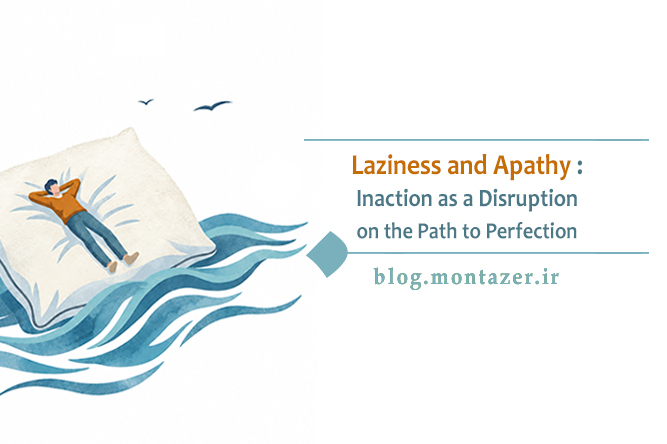
From Avoiding Responsibility to Striving for Perfection
Imagine someone who knows their tires are worn out, yet keeps putting off replacing them. They are fully aware of the risks of driving on worn tires, but there is a disconnect between knowing and taking action. This disconnect is precisely what can lead to vehicle damage, accidents, or harm to themselves and others. Or consider someone who starts exercising to stay healthy but gives up after just a few days. Here, the issue is not simply that they lack a workout plan; the main problem is their inability to stick with something they know is essential.
We see this exact pattern in every area of life—from family obligations and earning a living to education, worship, and even simple tasks like picking out the right everyday items or taking care of one’s appearance. Sometimes a person does not start a task at all (laziness), and other times they start it but leave it unfinished (apathy). In both cases, human potential goes to waste. If this pattern becomes a lasting habit in a person’s life, they stop growing and making progress. Growth requires more than just talent or knowing the right path; it demands consistent action, the ability to endure hardship, and sustained effort.
In this discussion, patience emerges as an essential quality for building character. To reach one’s full potential, people must distinguish between immediate desires and larger goals, enduring short-term hardship to achieve those goals. In contrast, laziness and apathy cause people to stop taking action. Therefore, this is not just a minor behavioral flaw; it directly connects to responsibility, long-term vision, eternity, and inner potential.
Laziness and Apathy: Two Barriers to Taking Action
Imam Baqir (Peace be upon him) states in Tuhaf al-Uqul: “Beware of laziness and apathy. They are the keys to every evil” [1]. This narration shows that laziness and apathy are not just small flaws in behavior, but rather the root causes of many other problems in life.
To understand this better, we need to know the difference between the two: A lazy person fears starting a task and confronting their own shortcomings. They lack the patience to handle difficulties along the way, so they constantly make excuses or shift responsibility onto others. They might know the right thing to do, but they lack the will to do it. This problem stems from weakness in faith and knowledge.
An apathetic person, on the other hand, goes one step further. They have the courage to start, but due to a lack of inner broader perspective and insight, they cannot finish what they began. For instance, they start exercising but quit halfway through, get married but neglect family responsibilities, or begin practicing worship without seeking to understand its deeper meaning and impact.
So the main difference is simple: Laziness prevents one from starting, while apathy stops them from continuing. Both lead to the same outcome: the inability to turn potential into action. Here, patience gives a person the strength to endure challenges and complete a task rather than merely endure suffering without purpose.
From this perspective, personal growth does not come from merely performing an action; it happens through the transformation that occurs as we act. If worship, education, or work is just a chore to cross off a list, the result is merely a repetitive routine. We might appear busy on the outside, but we are experiencing no real inner growth.
Existential and Epistemological Roots
The first root cause is the soul’s desire for comfort. Our soul naturally seeks comfort and avoids hardship and sustained effort. If we do not control this craving for comfort through awareness and will, we will always choose easy, meaningless tasks over valuable, challenging ones.
We might work hard to make money or gain social status in this world, yet make little or no effort toward our moral and spiritual growth, which is essential for eternal life.
This behavior is inconsistent with the existential structure of the human being. God did not create human beings merely for trivial and limited pursuits, because He breathed into us of His Spirit [2]. Describing the state of the inhabitants of Heaven, the Quran says: “As you look on, you will see there, bliss and a great kingdom” [3]. Yet, when we lose sight of eternity, we spend all our energy on fleeting worldly matters and fail to put enough effort into what truly matters.
The main problem is that we fail to prioritize. We might meticulously plan our work, yet have no plan for self-improvement or improving our family relationships. This is not just a lack of time; it is a failure to recognize priorities. Anyone who thinks only about today and ignores the future (eternity) will always pick the easiest option.
Additionally, weak faith causes people to retreat at the first sign of an obstacle. For such a person, worship and showing love to family may seem like separate, unrelated acts. If someone focuses only on the outward form of an action without seeking its positive effect on their character, worship becomes just a repetitive, ineffective chore.
Laziness and Apathy in Relation to Satan and Human Abandonment
From this perspective, Satan acts as an adversary who seizes every opportunity, and one of his subtle tactics is to induce laziness and lethargy. This does not mean blaming Satan every time we feel tired; rather, it means we must not let fatigue become an excuse to dodge responsibility. When a person decides to do something but abandons it whenever they find a small excuse, such as tiredness or laziness, their will weakens over time.
Regarding those who incur God’s anger, Imam Ali (Peace be upon him) said: “The most hateful creature in God’s eyes … is a man whom God has given up on and left to his own devices” [4]. When people stray from the divine path of growth and run away from their responsibilities, they effectively deprive themselves of divine guidance.
Laziness and apathy are not just bad feelings; they signal that a person is turning away from the path of growth. Humans do not grow without practice, consistency, and enduring challenges. Avoiding action is ultimately avoiding growth.
Personal, Family, and Social Consequences
Problems caused by laziness do not affect just the individual. We live in a society, and our actions impact others. Someone who fails to provide for their family does not just harm themselves; they undermine their family’s security and peace. The Prophet (Peace be upon him and his family) said: “Cursed! Cursed is the one who brings deprivation to his dependents” [5]. This responsibility goes beyond making money—it includes providing love, moral support, and meeting the family’s spiritual needs.
Marriage is not the finish line; it is the start of commitments. If someone neglects showing affection, raising children, or caring for their spouse emotionally, they weaken the family bond. Even small details like choosing clothes, wearing pleasant scents, and maintaining good grooming matter. The lifestyle of the Ahl al-Bayt (Peace be upon them) shows great attention to the preferences and tastes of family members. For example, one narration states that Imam Hussain (Peace be upon him) gave his wives their dowries and allowed them to use them as they wished [6].
At the social level, when someone neglects their duties, work piles up. Clearly, if everyone acts lazily, no society can thrive.
We must also realize that laziness is not always a lack of will. Sometimes, physical issues are to blame. Conditions like anemia, zinc deficiency, or thyroid disorders cause severe sluggishness. In such cases, it is completely wrong to label someone as “weak-willed” or “irreligious.”
Therefore, we need to find the root cause. If the issue is physical, proper medical testing, treatment, or dietary changes may help address the problem. While body and soul are connected, not every feeling of tiredness stems from a lack of willpower. An accurate diagnosis is the first step toward a cure.
Laziness and Apathy on the Path to Eternity
We cannot attain eternal life through inconsistent and aimless actions. This world is where we must attain a sound heart, and we can only gain this precious treasure by facing conflicts, accepting hardships, and overcoming challenges. If we fail to understand this, we will always remain consumed by temporary distractions and forget our main goal.
Thus, laziness and apathy form a destructive chain. This cycle first prevents us from realizing our potential, then creates problems for our family and society, and ultimately blocks us from our true purpose in life. To fight this plague, we must change how we view time and life itself. Life moves forward when knowledge leads to a decision, and that decision leads to consistent action.
Several practical ways can help overcome this affliction:
– Courage in Taking Responsibility: We must recognize what is right and act on it despite the difficulties. The goal is not to eliminate rest and recreation, but to avoid an excessive pursuit of comfort.
– Creating Structure: Sometimes a person makes an effort but fails to achieve results because they lack a plan. Small but consistent efforts are better than short-lived bursts of enthusiasm. As Imam Ali (Peace be upon him) says: “A little done continuously is better than much that causes burnout” [7], meaning that consistency in small actions can lead to great rewards.
– Focusing on Quality: The goal is not just to finish a task and cross it off, but to consider how deeply that action transforms us. If our worship or responsibilities do not improve our character, we must rethink our approach.
– Self-Commitment and Positive Action: We must commit ourselves to positive actions. Making a sincere vow or pledge can help us resist laziness.
– Seeking God’s Help: When our energy runs low, we must ask God and our heavenly family for strength. This prayer does not replace hard work; it gives us the strength to begin.
Finally, follow good role models. Consider the life of Allameh Muhammad Taqi Jafari, who never sat idle, even at home, if there was nothing else to do, he would sweep the floor. He did not do this because sweeping was a significant task, but because he refused to let his time go to waste.
References
[1]. Ibn Shuba Harrani, Tuhaf al-Uqul: The Masterpieces of the Mind, trans. Badr Shahin, Qum: Ansariyan Publications, 2000, p. 215.
[2]. Quran, 32:9.
[3]. Quran, 76:20.
[4]. Sharif Radi, Nahj al-Balaghah: The Wisdom and Eloquence of Ali: A Parallel English-Arabic Text, ed. and trans. Tahera Qutbuddin, Leiden: Brill, 2024, p. 144.
[5]. Muhammad Muhammadi Reyshahri, Mizan al-Hikmah (Scale of Wisdom), vol. 4, p. 1079, hadith 46, citing Bihar al-Anwar, vol. 103, p. 13, no. 62.
[6]. Muhammad ibn Yaqub, Kulayni, Al-Kafi, vol. 6, book 7, chapter 28, hadith 1, Thaqalayn, accessed October 3, 2026: https://thaqalayn.com/chapter/6/7/28.
[7]. Nahj al-Balagha, Saying 278.
Comments and questions
Ask a question or share your experience with this lesson.
After signing in and enrolling, you can join the discussion.
Be the first to ask a question about this lesson.