
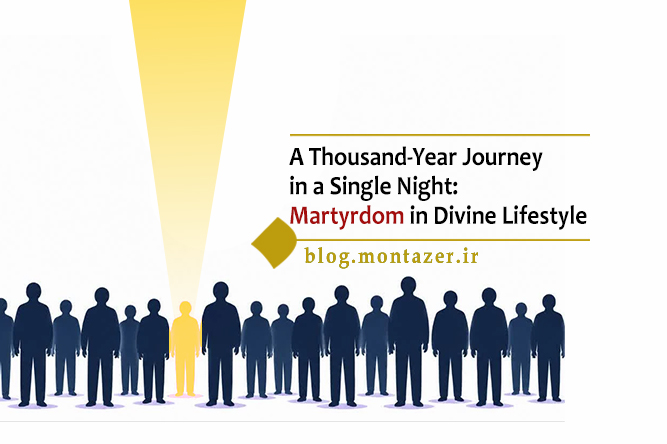
Martyrdom in Divine Lifestyle: The Culmination of a God-Centered Life
Martyrdom in divine lifestyle represents the culmination of a life centered on God in Islamic culture. What we see on the battlefield at the moment of death is only the final expression of a truth that has been taking shape within a person for years, months, or sometimes just a few days. If we regard martyrdom simply as a kind of death, we have missed its true meaning. Martyrdom is the outcome of a way of life in which a person rises above the self, devotes their heart to a higher truth, and gives everything they have in its pursuit.
This article explores the place of martyrdom in a divine lifestyle. It examines where martyrdom begins, what it truly means, how it shapes individuals and society, and why a martyr is considered alive.
The Human Being: A Traveler on a Journey
To understand martyrdom, we must first understand the human being. In the Islamic view, a human being is not a static, finished entity. Rather, each person is a traveler whose journey begins with the self and whose destination is Allah [1]. All human beings are destined to return to God. The difference lies in how they return: unwillingly and empty-handed, or consciously and eagerly.
Human beings possess a potential greater than anything around them. That is why nothing finite can fully satisfy them. Wealth, power, fame, and even a long life can diminish a person when these become the limits of their aspirations. Human beings realize their true potential only when they move toward something infinite. A God-centered life is one whose destination matches the full extent of human potential.
From this perspective, the value of life is measured by the depth and direction of one’s journey, not by its length. Someone may live for a hundred years without taking a single step beyond the self. Another person may, in a short time, travel a path that others fail to complete in a lifetime. This is what is meant by the saying that martyrs “complete a hundred-year journey in a single night.” In a person’s life, time is measured by the depth of their presence and the sincerity of their choices, not by clocks and calendars.
Two Essential Steps: Transcending the Self and Loving God
If the human journey leads toward God, the greatest obstacle along the way is the self. This refers to the self that wants everything for its own sake, judges everything in terms of personal gain and loss, and reduces the world to the limits of its own interests.
Self-Sacrifice: Self-sacrifice means putting another person or a higher truth before oneself. It has different levels: giving up possessions, comfort, reputation, personal ambitions, and, ultimately, one’s life. Martyrdom is the highest form of self-sacrifice, but it requires preparation. Someone who has never given anything up in everyday life will not be ready to give their life when faced with the ultimate test. Martyrdom comes at the end of a journey that begins with small acts of self-sacrifice.
Falling in Love: Letting go of the self is not enough. We cannot give something up unless our hearts are devoted to something greater. Letting go of the ego without filling that space with truth leads to meaninglessness. Love makes self-sacrifice possible and even sweet. A person who loves does not see what they give up as a loss, because they gain something better in return.
These two steps are actually two sides of the same truth: The more a person overcomes their lower desires, the more room they make for the Beloved; the deeper their love becomes, the easier it is to let go of the self. A martyr is someone in whom both movements reach their fullest expression.
The Path of the Heart and the Path of Reason: It is sometimes said that martyrs reached their destination without engaging in complex scientific or philosophical discussions. This does not mean that thought is unimportant. Rather, true understanding is knowledge that becomes part of a person’s very being, not merely information accumulated in the mind. A person may know a great deal about God without taking a single step beyond the self. Another may discover the truth so sincerely and wholeheartedly that no further argument is needed.
This direct, experiential knowledge is not merely a form of awareness; it is the deepest form of knowing. A martyr represents the highest form of awareness because they embody the truth through their actions and their very being. Reason shows the way, while love moves a person along that path. In a martyr, these two are inseparable.
The True Meaning of Martyrdom: A Conscious Choice in the Face of Death
Everyone dies, and death is inevitable. What a person can choose is how they die. A person may face death as a meaningless event, or consciously give their life for a worthy cause, turning it into a deeply profitable exchange. The Quran uses this very language: “Indeed Allah has bought from the faithful their souls and their possessions for Heaven to be theirs” [2]. A martyr sells what would eventually be lost anyway to the best possible buyers.
Martyrdom therefore has three fundamental characteristics:
- It is a conscious choice: A martyr knows what they are doing and why. Martyrdom is neither an accident nor an act of blind submission.
- It is voluntary: A martyr chooses this path freely.
- It is for the sake of God: Its ultimate aim is God and what God wills: truth, justice, human dignity, and the rights of the oppressed. Personal motives, resentment, or the pursuit of fame undermine its value.
These characteristics distinguish martyrdom from other forms of death. Suicide is an escape from life and responsibility, whereas martyrdom represents the highest expression of taking responsibility. A person who dies by suicide withdraws from the burdens of life, while a martyr carries the burdens of society and truth to the point of sacrificing their life. Suicide arises from despair, while martyrdom springs from hope and love.
Martyrdom and Social Responsibility
Martyrdom is not merely an individual or mystical experience concerned only with the martyr’s relationship with God. A martyr lives within society and gives their life in response to the needs of a particular historical moment. Wherever injustice, threats, or the danger of truth being lost arise, a believer feels a sense of responsibility. Martyrdom represents the highest expression of this sense of responsibility.
For this reason, martyrdom is deeply connected to social life:
A martyr’s blood awakens society. Sometimes words and arguments have little effect, but one person’s sacrifice can awaken the conscience of an entire community. A martyr is like a candle that burns to help others see the way.
Martyrdom can breathe new life into society. A society whose people are ready to make sacrifices is difficult to defeat. An enemy may have superior weapons, but it cannot easily overcome a spirit that does not fear death.
Martyrdom changes society’s hierarchy of values. In a society that understands the meaning of martyrdom, comfort, power, and wealth are no longer regarded as the highest values. A martyr shows everyone that some things are more precious than material life.
Thus, martyrdom represents both the culmination of an individual’s journey toward God and the highest form of service to others. In the Islamic view, these two are inseparable: the path to God runs through a sense of responsibility toward others.
The Culture of Martyrdom: Living as a Martyr Before Martyrdom
The most important thing to understand about martyrdom as a way of life is that its spirit is not limited to the battlefield. Not everyone becomes a martyr, but life itself is a battlefield, and everyone can live in the spirit of a martyr.
The culture of martyrdom means:
– Living for a Purpose Greater than Oneself: Anyone who understands their purpose as a human being and strives to fulfill it is already living, in part, according to the culture of martyrdom.
– Freedom from Attachments: A person who has no fear of death does not fear any worldly power. The courage to speak the truth and stand against falsehood grows out of this freedom.
– Harmony of World and Deed: A martyr affirms their beliefs through their sacrifice. The culture of martyrdom calls on people to show through their actions that their faith is more than a mere claim.
– An Ongoing Struggle against the Self: Before struggling against an external enemy, one must struggle against selfishness, worldliness, and inner weakness. Those who have not prevailed in this inner struggle will not remain steadfast in the outer one.
Martyrs had already embodied the spirit of martyrdom before sacrificing their lives. Before their physical death, they had already let go of their egos. As the saying goes, “You must first die to the self to become a martyr.” Martyrdom is the reward for a life lived in the spirit of martyrdom.
The Life of a Martyr: Why Is a Martyr Alive?
The Holy Quran states emphatically: “Do not suppose those who were slain in the way of Allah to be dead; no, they are living and provided for near their Lord” [3]. The life of a martyr can be understood in two dimensions.
Life in the Presence of the Lord
During their lifetime, martyrs bridged the distance between themselves and God. For this reason, death is not a separation from God for them, but a reunion with Him. What others may face with fear and regret at the moment of death becomes, for a martyr, the beginning of a reunion. Before death, the martyr has already answered for their deeds and entrusted their entire being to God. There is nothing left for them to answer for.
According to Islamic narrations, a martyr is forgiven from the moment the first drop of blood is shed. A martyr enters the hereafter with joy, having reached the Beloved they spent their entire life seeking.
Life Among People
A martyr also lives on in history and society. Their name, path, and message often become more prominent after their death than they were during their lifetime. Wherever someone makes sacrifices and stands against injustice, the martyr’s spirit lives on through that person.
Karbala is a powerful example of this truth. Imam Hussain (Peace be upon him) and his companions were defeated outwardly, yet their sacrifice continues to inspire movements for freedom centuries later.
Karbala: A Comprehensive Model of Martyrdom
Everything discussed above came to its fullest expression on the Day of Ashura. In Karbala, martyrdom was:
– Conscious: Imam Hussain knew from the outset where his path would lead.
– Voluntary: On the eve of Ashura, his companions were free to leave, yet they chose to stay.
– Fueled by Love: Imam Hussain’s companions competed with one another to give their lives and regarded martyrdom as sweeter than honey.
– Rooted in a Sense of Responsibility: Their goal was to revive the faith and reform the Muslim community: “I have risen to seek reformation in the community of my grandfather” [4].
– Enduring: Its message transcended a historical event and became a living tradition.
People from every walk of life were present at Karbala: the elderly and the young, women and men, religious scholars and laypeople, free people and enslaved people, and even someone who had been in the opposing army the night before. This shows that the path of martyrdom is open to everyone. It does not require an illustrious past or extensive knowledge; it requires a sincere choice. In just a few hours, Hurr completed a spiritual journey that others might not complete in a lifetime.
Martyrdom in Modern Life
For people today, martyrdom in divine lifestyle is not merely a memory of the past; it is a standard by which to measure life. At a time when consumerism, pleasure-seeking, and individualism preoccupy people, martyrdom reminds us that:
– A meaningful life is one devoted to something greater than oneself.
– True freedom means freeing oneself from the grip of one’s desires, not satisfying every one of them.
– Death is not the end. The way we live determines how we die.
– Anyone, regardless of their position in life, can direct their life toward the horizon of martyrdom through self-sacrifice and love.
Preserving the culture of martyrdom means upholding these values in both personal and social life. A society that loses this culture gradually becomes a society of self-centered individuals who are unwilling to stand against injustice or make sacrifices for any ideal.
In Islamic culture, martyrdom represents the culmination of a God-centered way of life. The journey begins with understanding the human being as a traveler on the path toward God. It progresses through two essential steps: self-sacrifice and love. It takes shape through a sense of responsibility toward truth and one’s fellow human beings, and ultimately reaches its highest point when a person consciously and freely gives their life in the way of God.
A martyr has died to the self before physical death and has come alive in God. For this reason, death is a reunion for the martyr. They remain alive in the presence of their Lord, receiving sustenance from Him, and continue to live on in history and society as their path carries forward. The culture of martyrdom teaches everyone, including those who never enter a battlefield, how to live a life filled with self-sacrifice, love, responsibility, and a journey toward the infinite.
References
[1]. Quran, 2:156.
[2]. Quran, 9:111.
[3]. Quran, 3:169.
[4]. Sayyid Muhammad Rizvi, “Imam Husayn’s (‘A) Mission: Reforming the Ummah,” Al-Furqan, vol. 1, no. 2 (3 Muharram 1427 / 2 February 2006), Al-Islam.org, https://al-islam.org/imam-husayns-mission-reforming-ummah-sayyid-muhammad-rizvi/imam-husayns-mission-reforming-ummah.
Comments and questions
Ask a question or share your experience with this lesson.
After signing in and enrolling, you can join the discussion.
Be the first to ask a question about this lesson.