
H1 Beyond Meaninglessness: Failure as Excess of Finite Perfections
Consider a researcher who has spent years working in laboratories or libraries. Throughout those years, they were driven by an underlying belief: “If I earn a PhD or if I prove this scientific theory, I will finally find lasting peace and inner fulfillment.”
They progress through academia, publish numerous articles, and eventually attain the highest academic standing in their field. Yet at the very peak—at the moment when they expect to feel complete and fulfilled—a heavy silence and a terrifying spiritual void take the place of that fleeting sense of achievement. They realize that the summit was not the answer to their inner longing; the degree has been earned, the article has been published, and they have earned the recognition of their colleagues, yet the fundamental thirst within them remains.
This phenomenon is neither a temporary instability nor mere fatigue; rather, it is a direct confrontation with the contradiction between the unlimited nature of human inner desires and the limitations of material existence. A logical examination of this gap reveals that existential crises, such as deep depression and the mental impasse that can lead to suicide, stem from a fundamental miscalculation in identifying the proper object of humanity’s authentic inclinations.
The Innate Structure of the Soul and Fulfilling the Desire for Infinity
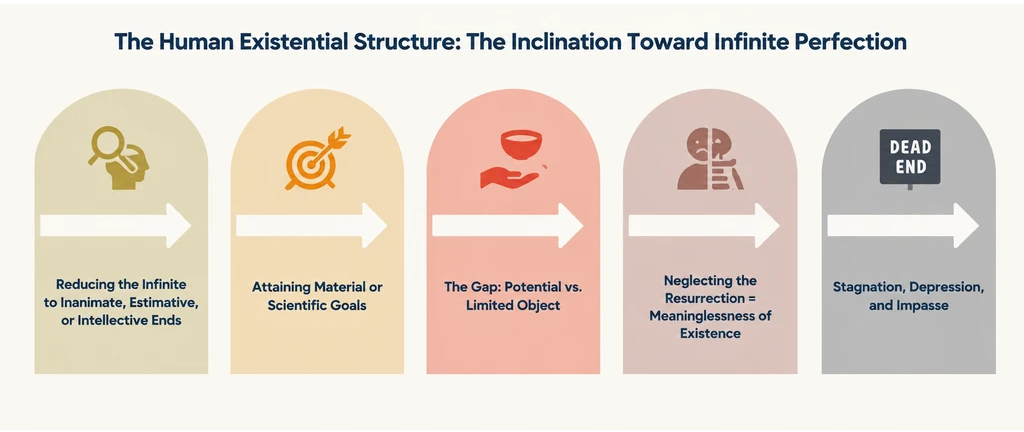
To analyze fundamental human behavior, one must consider innate human nature and desires. From an ontological perspective, human beings intrinsically tend toward the infinite. This characteristic is not a personal choice that can simply be ignored; rather, it is an inseparable part of our existence. Human beings never stop after reaching a goal; rather, every peak they attain becomes a starting point for pursuing a higher one. This inherent quality is the driving force behind humanity’s continual striving throughout life.
Based on the five principles of desire, the inclination toward the infinite points to the existence of a real, unlimited perfection in the external world. The fundamental challenge arises when a cognitive error occurs in applying this desire to its proper object. The problem is that although human beings are intrinsically thirsty for the infinite, they mistakenly attempt to quench this deep need with limited, material things. This endeavor inevitably fails because the boundless demand of the soul cannot be answered by the finite resources of this world. This disproportion between desire for infinity and the limitation of objects creates a fruitless effort that ultimately leads to spiritual erosion and exhaustion.

Levels of Qualities: Authentic vs. Estimative
To understand logically why humans fail to achieve peace, we must rationally categorize the qualities we pursue. In a comprehensive analysis, qualities fall into two categories:
- Limited and Imperfect Qualities: These include sensory, imaginative, estimative, and intellective qualities.
- Absolute and Authentic Qualities: Supra-rational qualities that transcend time, space, and decay and correspond to the non-material nature of the soul.
Sometimes, due to negligence regarding the true nature of their needs, humans make material qualities, superficial luxuries, or conventional positions the ultimate goal of life. They imagine that attaining a specific material standing or social status will quiet their inner thirst. However, because these material and conventional qualities are inherently limited, once attained, they immediately reveal their inability to provide lasting peace. Material qualities partake of matter, and matter is constantly changing, subject to decay, and inherently limited; thus, it cannot serve as the ultimate goal for a being with trans-material inclinations. When a being with an infinite need encounters a limited target, harmony is impossible; the target is consumed and disappears, yet the fire of desire continues to burn.
Why Academic Achievement Cannot Satisfy the Desire for Infinity
Acquiring knowledge and discovering relationships among phenomena is one of the noblest of human pursuits; nevertheless, even this lofty endeavor meets the same fate as other limited qualities if treated as the ultimate objective. Perfectionists often devote their entire lives to mastering empirical, philosophical, or technical fields. They assume that knowledge as such—within the framework of acquired concepts and propositions about the world—is the ultimate goal that will extinguish their thirst.
At this point, a cognitive contradiction arises:
– Upon entering each new academic stage, the individual initially experiences progress and proximity to the goal.
– As the individual masters each body of knowledge and moves beyond its formal boundaries, they realize that what they have learned is finite, specific, and therefore limited.
– The soul, demanding infinite truth, finds itself empty again after reaching and mastering that academic level.
This failure to feel satisfied after reaching high academic or research levels does not imply that knowledge is worthless; rather, it proves that acquiring knowledge is structurally incapable of fulfilling the desire for infinity. Limited knowledge cannot satisfy the boundless capacity of the human soul; consequently, recognizing its inability to provide lasting peace results in a deeper sense of frustration. The individual thinks: “If knowledge, humanity’s highest achievement, cannot satisfy me, then nothing else can.” This flawed inference is the first spark of philosophical despair.
The Logic Behind Meaninglessness
One of the most important aspects of understanding despair ontologically is analyzing the human relationship with worldly decay. By its very existential structure, the world is finite, changing, and defined by loss. No worldly phenomenon possesses eternal stability. If a person with high analytical intelligence observes the world, they clearly perceive this structural defect. They realize that wealth vanishes, health degrades, emotional bonds break, and acquired knowledge reaches a definite ceiling. Therefore, the proposition “The world in itself is futile and insufficient” is a true and accurate discovery. The logical flaw occurs when one misinterprets the limitation and defect within a part of the world as the worthlessness of the entire system of existence.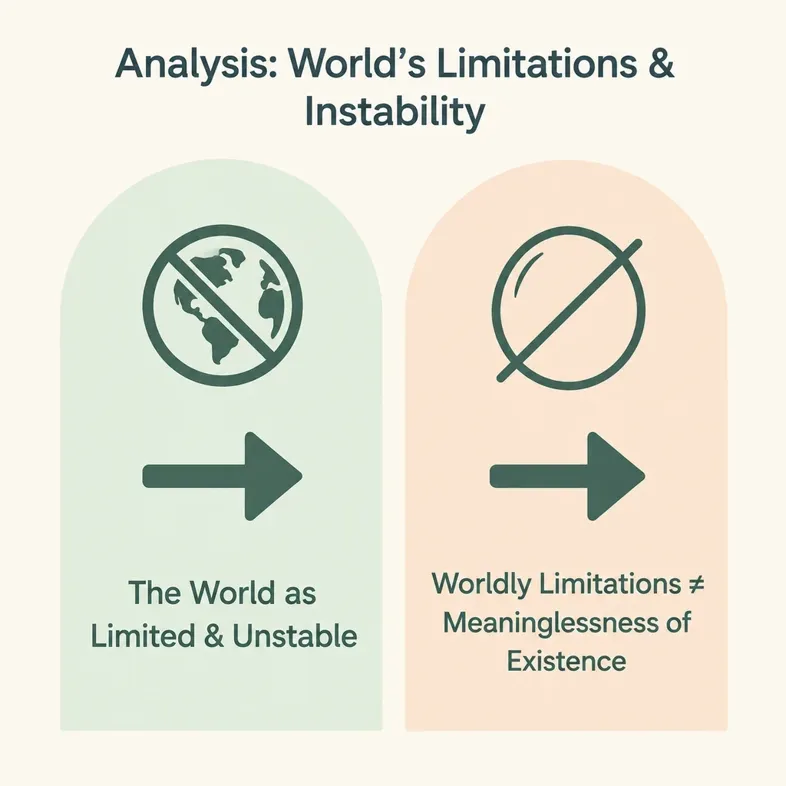
When a person recognizes the imperfection of the world without perceiving the horizon beyond matter—the reality of the resurrection and eternity—their reasoning leads them to an inevitable conclusion: “The universe lacks meaning, and I am trapped in an endless snare of unfulfilled needs.” The reflection of this way of thinking in intellectual literature has given rise to a dark worldview that presents existence as a dead end, driving many individuals and groups into profound despair and nihilism. In the absence of a perspective linking existence to the infinite, every effort at fulfilling the desire for infinity ultimately proves futile, reproducing itself in the form of nihilistic philosophy.
From Epistemic Failure to the Phenomenon of Stagnation and Depression
Depression is not merely the accumulation of psychological distress; rather, it can be understood here as an “existential halt” in the course of human existence. Movement always requires an ultimate goal; if the goal is negated, movement becomes intrinsically meaningless. When a person tests every conceivable goal before them—biological, financial, status-related, or scholarly—and finds that achieving each goal intensifies their thirst rather than filling the void, they become passive toward life.
This existential halt is the philosophical expression of what is commonly termed depression. Internally, the individual concludes they have reached a dead end. A dead end means the forward path is blocked and returning to the past resolves nothing. In this state, the impossibility of satisfying the desire for the infinite does not stem from a defect in human essence; rather, it results from expending existential energy on goals incapable of bearing the meaningful weight of life.
Imperfection and the Desire for Nonexistence
Why can an impasse caused by a lack of inner peace ultimately lead to suicide? Analytically, suicide is a paradoxical action: While attempting to end their life, the individual is actually pursuing their most authentic desire, which is “freedom from imperfection and suffering.” No one desires non-existence for its own sake, as “not being” cannot be the goal of any rational or instinctive drive. What the individual seeks at the moment of suicide is an end to suffering and an escape from the state of impasse, rather than the destruction of their very existence.
When a person finds all earthly paths blocked and sees no prospect of connecting to the infinite source of perfection, they view their existence as a heavy burden of unanswerable needs. Imagine a thirsty person in an endless desert running toward every mirage, only to encounter heat and sand upon arrival. Suicide stems from this mental deadlock; a human who fails to satisfy their infinite desire within a finite world attempts to erase the problem itself in order to put an end to this unresolved inner conflict.
The Cycle of Crisis in an Estimative Lifestyle
A lifestyle guided by conventional, estimative, and variable qualities inevitably reproduces exhaustion. In such an order, human worth is reduced to consumption metrics, academic and professional credentials, and social approval. These estimative qualities cannot provide a foundation for stability and inner peace because they have no authentic existence of their own; their continued existence depends on changing social perceptions or individual illusions, making them incapable of serving as a foundation for lasting inner stability and tranquility.
As long as goal selection relies on limited qualities, the attempt at fulfilling the desire for infinity will encounter the inherent limitations of those very targets. Reducing transcendent needs to material appearances and objects of the estimative faculty is a prime example of mistaking a limited manifestation for the reality itself, ultimately leading to loss and wasted human potential.
The way out of this destructive cycle requires restructuring one’s intellectual framework and a more complete understanding of the realms of existence. The first step to escaping nihilism and decay is courageously acknowledging that the world alone cannot quench the infinite human soul. This acceptance must not lead to passive despair; it must serve as a philosophical basis for discovering another truth.
Just as physical thirst is definite proof that water exists in nature, the soul’s boundless yearning for infinite perfection is conclusive proof of an eternal, infinite truth. The historical error of many thinkers was stopping at the realization that “The world is futile” without proceeding to affirm the reality of the hereafter. When the concept of a transcendent purpose and eternal life are incorporated into our understanding of human existence, the entire value system shifts:
❶ Worldly phenomena cease to be ultimate goals and become instruments for the journey.
❷ Acquiring knowledge is no longer the ceiling of existence, but a means of expanding the soul’s capacity for understanding.
❸ The loss of material things is no longer a catastrophe, but is understood as an inherent feature of this limited world.
In this framework, a real path opens to satisfy infinite desire by connecting to the boundless source of existence. The impasse is overcome because the horizon ahead is no longer blocked by the limits of death and material existence.
Overcoming the Impasse by Redefining the Role of Qualities in Everyday Life
How can an individual apply this logical reasoning to daily decision-making? Implementing this model requires reassessing one’s expectations of external achievements. If a person understands that academic degrees, wealth, and status cannot fully satisfy the soul, attaining them will not necessarily lead to shock, spiritual emptiness, or depression. They acquire knowledge to comprehend the relations of the universe while seeking the true fulfillment of the soul on a higher horizon.
When this epistemological shift occurs:
- Upon reaching an academic tier, the individual does not view it as the ultimate end of existence, but treats it as a temporary phase.
- Encountering a deadlock in material or emotional matters will not be regarded as an existential deadlock in itself, because their identity and meaning are not tied to unstable material or estimative qualities.
- Feelings of fatigue and emptiness are interpreted as internal signals that the soul is yearning for a higher truth rather than self-destruction.
Therefore, managing authentic inclinations and directing them toward their true desire is the only rational approach to preventing despair and paralyzing impasses. Attempting to satisfy infinite desire without correctly defining its true object is like building a heavy structure on unstable ground—the collapse is ultimately inevitable.
Crises of meaning stem from the structure of human inclinations and how existence is perceived. Humans naturally carry an innate inclination toward the infinite. Failing to distinguish authentic, unlimited qualities from limited, estimative, and inanimate ones leads individuals to exhaust their energy on targets that offer no lasting peace. Experiencing this failure at the height of material or academic success creates the critical moment where a flawed understanding of existence prompts them to regard the universe as a whole as meaningless.
Overcoming this deadlock and preventing paralyzing depression requires reconstructing our understanding of the world and the purpose of our desires. True peace becomes attainable only when human purpose is defined beyond imaginal qualities, social status, and limited academic accomplishments, and the truth of existence is understood as connected to eternity. Otherwise, every step up the ladder of worldly success merely highlights matter’s inability to quench the soul, leaving us in bewilderment and exhaustion. A comprehensive understanding of existence and proper knowledge of the self can lead to fulfilling the desire for infinity, breaking the chains of stagnation, depression, and self-destructive thoughts.
Comments and questions
Ask a question or share your experience with this lesson.
After signing in and enrolling, you can join the discussion.
Be the first to ask a question about this lesson.