

Is the Fear of Death Natural? Why Do People Face Death Differently?
Death is the most certain and universal reality of human life. No one can escape the reality of death, but what creates a meaningful difference among people is not death itself, but rather how they confront it. For some, contemplating death is anxiety-inducing, heavy, and downright terrifying, to the point where they prefer never to mention it, ignore its signs, or push it to the margins of their minds with constant distractions. Conversely, there are those who view death with peace, acceptance, and sometimes even eagerness. This difference in reactions indicates that the issue of death goes far deeper than a mere biological or psychological event—it is rooted in the profound layers of our existence.
Death is the moment when many of life’s superficial veils are lifted, and we inadvertently come face-to-face with the very foundations of our being. Whatever we have attached our hearts to throughout life, and whatever we have built our identity upon, reveals itself when confronting death. Therefore, one’s approach to death is a clear mirror reflecting their attitude toward life and the horizon they have envisioned for their future. For someone who views death as the absolute end and the destruction of everything, it is entirely natural to face it with anxiety, denial, or mental escapism—so much so that even the thought of it disrupts their psychological peace.
A point worth pondering is that the fear of death is not necessarily limited to failed or deprived lives. Sometimes, this fear manifests in lives that appear highly successful, prosperous, and stable from the outside- lives filled with career advancements, social prestige, and material wealth. In such circumstances, any sign of illness, aging, or end of life severely shakes their sense of security because their entire identity is built upon things that death directly threatens. Here, the fear of mortality is less a sign of psychological weakness and more a symptom of a limited life horizon.
In contemporary psychological approaches, a severe and persistent fear of death is known as “death anxiety” or, in its acute form, “thanatophobia.” The primary focus here is on reducing anxiety symptoms and helping the individual adapt to an inescapable reality. While these approaches play a vital role in alleviating psychological pressure, they rarely address the fundamental question: Why has death become so terrifying in the first place? And what is the relationship between fearing death and a person’s definition of life, their true existential truth, and their future?
Different perspectives on humanity and the universe offer varying answers to this question. Some consider death the absolute end of life and a complete severance of existence, while others see it as just another stage in the journey of life. This difference in perspective is exactly what makes human experiences of death so drastically different. The question now arises: Is the fear of death a natural and unavoidable phenomenon, or is it a sign of disharmony between a person’s true essence, their life’s horizon, and their chosen way of living? Perhaps the main issue is not why we fear death, but rather how we have lived that makes death seem so threatening and scary.
The Materialist View of Death
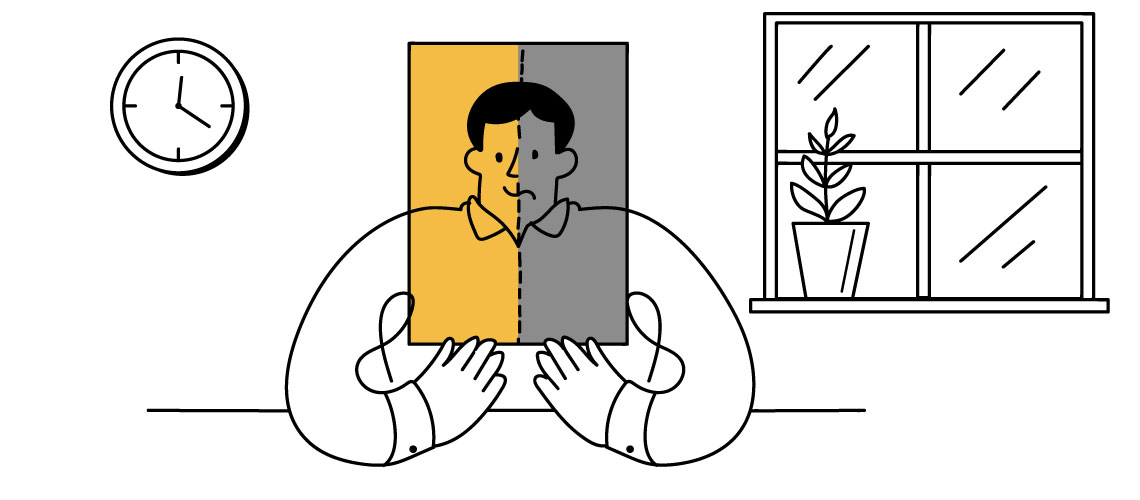
In the materialist view, death is the finish line, the moment when all experiences, attachments, memories, and achievements are permanently severed. Within this framework, the human is a being limited to just a few decades of earthly life, and death means absolute termination and non-existence. When death is defined this way, confronting it usually manifests in one of two forms: a pathological fear of death or a facade of indifference.
For some, death is a constant, anxiety-provoking threat. If death is the end of everything, then everything the individual cherishes—from youth and health to social status, relationships, and pleasures—is at risk of total annihilation. This fear is rarely expressed directly; instead, it shows up as an extreme attachment to worldly pleasures, an obsessive pursuit to maintain security and youth, and a mental flight from any sign that reminds them of the end. Such an individual might avoid talking about death altogether or keep themselves perpetually busy to avoid thinking about a finite future.
In contrast, others accept death as a natural end, claiming, “We are in this world for a short time, and we should make the most of it.” At first glance, this seemingly rational acceptance might look like realism or bravery. A person who claims they do not fear death may appear calm and balanced; however, this indifference is not always a sign of inner well-being. In many cases, behind this superficial calm lies a hidden emptiness.
Such a perspective usually holds up as long as life is running smoothly. But when faced with serious crises—like a severe illness, major failures, or a genuine brush with death—this calmness quickly comes to an end. When life holds no meaning beyond fleeting pleasures, facing the end exposes a deep void that no rational justification can fill.
What unites these two seemingly different reactions is their shared definition of death as the absolute end. One is terrified of this end, while the other pretends death does not matter. Yet, in both scenarios, the horizon of life is strictly limited to this physical world. Therefore, a lack of fear is not always a sign of health, just as severe fear does not necessarily equate to personal weakness.
The Fitrah-Based and Religious View of Death
In the fitrah-based and religious perspective, death does not mean the end of life; rather, it is a transition phase to another realm of existence. This is why in Islamic verses and traditions, death is referred to as Tawaffa [1] and Wafat—words that mean “to be taken fully,” not “to be destroyed.” This is the core difference between this view and the materialist one. From the fitrah-based perspective, a person does not perish with death; instead, the way of their presence in the universe simply changes. Death is not a disconnection from existence; it is crossing over from one form of living into a vaster, more complete one.
This transition is a normal continuation of the journey that began at the dawn of life and shares an essence similar to birth. Just as a fetus leaves the mother’s womb to enter a much broader world, death is the exit from a restricted universe into a far more expansive realm of life. If a fetus had the capacity to understand and judge, it would likely consider leaving the womb as the end of its life because all its perceptions and attachments are tied to that tight, dark space. In reality, what occurs is a fresh birth and the beginning of a more perfect stage of living. In the logic of our fitrah, death holds the exact same relationship to our worldly life.
In this view, death is directly linked to divine mercy. What we experience of God’s mercy in this world is merely a limited reflection of a much vaster reality. Prophet Muhammad (Peace be upon him and his family) said: “The day God created the heavens and the earth, He created 100 parts of mercy, placing only 1 part of it on earth… and reserving the other 99 parts for the Day of Judgment” [2]. Based on this, death is not an entry into darkness and a void; it is the opening of a door to a realm where the ultimate share of divine mercy is revealed.
Therefore, in the religious and spiritual view, death can be accompanied by peace, hope, and even eagerness. Not because this world is worthless, but because this world is not the entirety of reality. This perspective does not deny or condemn fear; instead, it broadens one’s understanding of life and its continuation, clarifying death’s rightful place on the path of growth and perfection.
Why Do Even Religious People Sometimes Fear Death?
Experience shows that even religious individuals sometimes suffer from anxiety and unrest when facing death. If this reality is misunderstood, it can lead to simplistic judgments—as if any fear of death is a sign of weak faith. However, the issue is much deeper than these superficial assumptions.
In the religious view, there is a profound difference between “having a belief” and “internalizing a belief.” Many people intellectually and verbally believe in the hereafter, but this belief has not yet settled into the depths of their souls to the point where it can guide their emotions and reactions during critical moments, like facing death. Under these circumstances, the fear of death is not a denial of the hereafter; rather, it is a sign that their ma’rifa has not yet transformed into absolute heartfelt certainty.
In spiritual logic, the heart is the true seat of our real fears, hopes, and attachments. Someone might conceptually believe in life after death, but their heart remains firmly anchored in this world. In this state, the fear of mortality is actually the fear of being separated from one’s attachments, not a fear of death itself. We are terrified of being separated from the things we have invested our existential asset into. If the heart is deeply rooted in the material world, detaching from it will naturally be agonizing and anxiety-inducing.
Sometimes, the fear of death in devout individuals has a completely different root. It is a fear stemming from taking the accountability of one’s actions seriously, the dread of a bad outcome, and a heavy sense of responsibility toward the purpose of creation. Unlike materially-grounded fear, this type of fear can be highly constructive. It pushes the individual toward mindfulness, self-reflection, behavioral correction, and greater preparation for the journey ahead. Thus, within a religious framework, fearing death does not always mean one thing: Sometimes it is a sign of weak spiritual awareness, sometimes a result of attachment to fleeting worldly things, and sometimes it is a beautiful manifestation of spiritual awakening and faithful responsibility. What truly matters is diagnosing the source of this fear and its role in one’s personal growth.
Practical Strategies to Reduce the Fear of Death
The fear of mortality cannot be cured with simple advice, nor does it vanish by simply telling someone, “Don’t be afraid.” The root of this fear lies not in the mind, but in one’s lifestyle. A person who fears death does not actually have a problem with death itself; their problem is being unprepared for the transition. Just as a sick body cannot enjoy water and may even find it irritating, a soul that has not been shaped to be compatible with the living conditions of the hereafter will experience anxiety merely at the mention of death. Death is a mirror showing us which environment we have been training for: staying in the tight womb of this world, or being born into a limitless realm?
The path to reducing the fear of death begins with intimacy and familiarity. Humans naturally fear what they are not familiar with. For someone who has spent their entire life cultivating this worldly life while remaining entirely alienated from the hereafter, it is perfectly natural to fear moving out. Imam Sadiq (Peace be upon him), quoting Abu Dharr, said: “You have built up this world and ruined the hereafter, and you dislike moving from a flourishing home to a ruined one” [3]. However, if we slowly begin to familiarize ourselves with our eternal, immortal self—if our relationships, choices, and attachments are not limited to fleeting, sensory, imaginal, and estimative assets—death transforms from a vague threat into a familiar transition. This familiarity cannot be achieved through mental affirmations alone; it must be actively practiced through our choices, relationships, and lifestyle.
One of the foundational exercises on this path is “voluntary death.” This means consciously placing ourselves in the position of death before it actually arrives. We must ask ourselves: If I were to enter the Barzakh today, what would I take with me? Which of my relationships will endure, and which will be permanently severed here? If this exercise is done correctly, it does not induce depression or pathological fear; rather, it gives direction to life, corrects our choices, and regulates our dependencies.
The fear of death is one of the signs of spiritual poverty—meaning the heart has become overly entangled with things that are not meant to last. The more our existential asset is focused on perishable things, the more intense the pain of separation becomes. Conversely, someone who has not tied their bonds solely to people and material possessions, but instead sees them as a bridge to divine proximity, will not fall apart at the moment of separation. They know that these separations are temporary and that the ultimate connection remains intact.
Another crucial practice is shifting our perspective on loss. If the death of loved ones is solely defined as “losing” them, it is naturally terrifying. But if it is viewed as a “transition to a vaster womb,” our grief takes on a much healthier form. The sorrow is still there, but it does not turn into despair and denial. The individual understands that their loved one has moved from a narrow prison into an expansive realm, and this very realization gradually diminishes their own personal fear of dying.
The fear of death subsides when a person feels their life has been meaningful. Someone who has spent every day of their life investing in things that hold value beyond the grave will not fear arriving in that realm. But someone who has spent all their lifetime on things with an expiration date limited to this world will, naturally, be terrified of the end. Prophet Muhammad (Peace be upon him and his family) famously stated: “People are asleep; when they die, they wake up” [4]. Whether we feel panic or peace in the face of death is simply an indicator of how “awake” we already are right now.
What is your opinion? Do you believe that peace or fear in the face of death stems purely from a person’s beliefs, or is it fundamentally tied to their lifestyle and everyday choices? Leave your thoughts in the comments!
References
[1]. “[It is] Allah [Who] calls back the souls [of people] upon their death…” (Quran, 39:42)
[2]. Al‑Fattāl al‑Nīshābūrī, Rawḍat al‑Wāʿiẓīn wa Baṣīrat al‑Mutaʿiẓīn. Qom: al‑Sharīf al‑Raḍī Publications, n.d. vol. 2, p. 502, “Part Two: A Session on Hope and the Vastness of God’s Mercy.”
[3]. “A man came to abu Dhar and asked, ‘O abu Dhar, why do we dislike death?’ He said, ‘It is because you have developed the world and destroyed the next life and you dislike moving from developed to that which is mined.’” (Kulayni, Al-Kafi, Volume 2, Book 1, Chapter 203).
[4]. Ibn Maytham al-Bahrani, Sharh al-sad kalimeh-ye qisar, p. 54.