
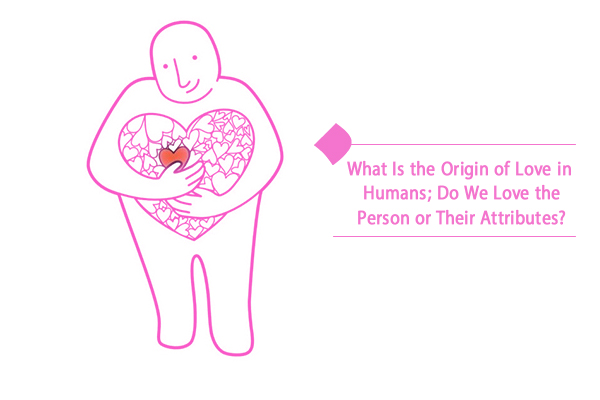
Why Do We Fall in Love, and What Is the Origin of Love in Human Beings?
World literature is replete with tales of love, narratives of devotion, waiting, and the tireless efforts of the lover to achieve union with the beloved. These stories are both entertaining and hold a deep pleasure, as humans are inherently beings inclined to love, possessing an urgent need to express and receive it. Love is a powerful force that gives a person a sense of vitality and grants depth and meaning to life. A person without love and affection is like a walking dead person, who has neither the capacity to face problems nor the motivation to be alive.
Nevertheless, many loves and attachments are only passionate until they lead to union. It is as if the pleasure of love lies in separation and distance from the beloved, and once the gaps are closed, the lover’s heart ceases its turmoil and excitement. In some cases, love fades entirely, giving way to hatred and repulsion. This issue is not limited to the love between two people; it is also true for a person’s love and interest in anything else.
But why is this so? Why is it that after a while, we grow tired and disillusioned with a person for whom we have moved heaven and earth, a position we have desired for years, or an object for which we have put in great effort and expense? What happens that our heart’s condition changes, and we no longer enjoy the things or people we were once fond of?
Ultimately, what is the origin of love in humans? What factor awakens the power of seeking and desiring within us? Can every emotional relationship and every form of attachment be called love? What are the characteristics of true love, and what consequences follow from failing to achieve it?
The Biological Perspective on the Origin of Love
What is the origin of love in humans? What happens inside us that makes us grow fond of a person or a thing? Scientists in the field of biology consider love and affection to be the result of hormonal secretions. They believe this emotion is the product of stimulating the hypothalamus in the brain. When the hypothalamus is stimulated, the hormone dopamine is released into the body, which gives the individual a sense of euphoria and pleasure. From that point on, the person is constantly excited and thinks about the person or thing they love at all times. The release of dopamine creates the same state in the body that addictive substances such as cocaine produce. Every time the lover thinks of their desired person or beloved, their dopamine levels rise, and that initial feeling of euphoria is repeated. This is why they want to revisit these thoughts over and over again.
While these descriptions are acceptable in their own right, they only explain the chemical reactions within the body and do not provide us with information about the reason of that initial attraction and pull. Furthermore, biological scientists identify the brain as the source of human love and describe the process of falling in love as an entirely physical process.
In previous articles, we discussed the difference between Islamic and Western self-knowledge and stated that empirical scientists, influenced by Western philosophy and anthropology, attribute all of human’s internal transformations to the body, viewing the soul not as a non-material dimension but as a part of the brain. Given this, it is entirely natural for these scientists to have a purely material and bodily outlook on the subject of love as well. Empirical sciences are very limited methods for knowing humans and only examine their physical transformations, whereas love is an entirely spiritual matter that deals with the soul and the heart. Any reaction that occurs in the body is a result of the stirrings and transformations of the soul.
But what truly is the source of our initial pull toward the beloved, and what factor constitutes the origin of love in humans?
What Is Love a Product of?
Love, in the first instance, is the product and consequence of need. The origin of love in humans is the need that a human has for their beloved or their desired object. If there is no need, no quest will be formed, and no pull toward the desired object will be created within us. For example, it never crosses our minds to enroll in literacy classes, nor do we have any interest in attending them. We possess sufficient reading and writing skills, and if we show interest in acquiring knowledge, we want to achieve something higher than what we already possess.
Human beings always seek something they lack. Once they acquire that very thing, disillusionment sets in. According to Plato, “a man turns with great love, and zeal to something, but on attaining it, that longing dies away, and ends there. It is the beginning of weariness: dislike and escape.” Union is the burial place of love and the beginning of disillusionment, hatred, and escape [1]. It does not make sense that we would naturally want something, only to reject it once we get it. So, why is this the case? The reason must be sought in the desire for perfection in the human being.
The human is a being that cannot love the limited. The fitrah in human is designed in such a way that it hates flaws and shortcomings and desires everything at the highest level of perfection. We are constantly inclined toward things or people that demonstrate degrees of perfection, and even if we are sometimes drawn to flawed or impure individuals, it is not because of their impurities; rather, it is due to the qualities they exhibit. These qualities might be a beautiful face or physique, power, wealth, and social status, or ethical qualities such as generosity, kindness, and bravery. Therefore, our desire and quest for anything, in general, stem from the quality of that thing and the feeling of need we have for that specific quality.
In addition to all of this, we also have a need for love itself—meaning, besides needing to be loved, we need to love others. At the beginning of the article, we stated that humans are inherently inclined to love and cannot help but give love. Our need for love is like our need for oxygen. If there is no one for whom we can expend our emotions, and sacrifice for, we become spiritually frustrated and ill. This feeling is so powerful that it sometimes drives people toward excessive love for animals and even objects. These behaviors are abundantly found, especially in Western societies where the lack of spirituality is more severe.
There Is Only One Love in the World!
There’s no denying that humans are driven by love. There is no person in the world who is not a lover and does not dedicate their energy and time to reaching someone or something. It is only the nature of our attachments that varies. Some are lovers of inanimate perfections. When they think of luxury cars, extravagant items, precious jewelry, and the like, their hearts pound, and like any lover, they are willing to make sacrifices to attain these beloved objects. Some are lovers of vegetative perfections. They spend long hours in front of the mirror on their grooming and appearance, or by the stove cooking all kinds of delicious foods. Others are lovers of animalistic perfections. Their thoughts are consumed day and night with obtaining a certain managerial position or a specific social status; or they’re obsessed with a new person they met, convinced that if they do not end up together, life is over! The last group consists of those who seek brighter and more sacred perfections: scientific and intellective.
The human inclination toward all of these is a result of “need.” In all these cases, there are degrees of perfection, and we need all of these perfections. This is why we are drawn to them like iron filings to a magnet. But the strange thing is that our hearts are not calmed by possessing any of them! That is, even though all these are perfections, they are lovable, and we need them all, none of them completely fill our hearts. Why? Because they are limited, and the human being hates limitation.
We are seekers of the Infinite, and if we show interest in these qualities, it is not for their own sake. This is because they remind us of our True Beloved. Woman, man, power, wealth, beauty, knowledge, and everything in the world are all reflections of a small part of God’s perfections. Since our soul was created from the Spirit of God, and the very essence of our being is the love of God, wherever we see a sign of our Beloved, we follow it. In reality, we imagine that we have fallen in love with a certain lady or gentleman. But the truth is, we have not fallen in love with them, we have fallen in love with their qualities! They themselves possess nothing. Neither they, nor any other being in the universe, possess anything inherently. Everything anyone has is from God, and every being is a manifestation of God’s perfections. There is only one “Being” in the universe, and that is God. All others derive their existence from Him and have no independent essence. Therefore, if we want to summarize everything we have mentioned in one sentence, we must say: “The origin of love in humans is God Himself!” Even someone who denies God is, in their essence, a lover of God because they are a lover of the Infinite, and the Infinite has only one manifestation.
“Prophets have not come to teach people the love of God, and His worship, for this is inherent in human fitrah. They have come to show the difference between the right and wrong paths, and tell the human beings that they are really in love with Absolute Perfection. If you think that money or social status in life is a perfection, you are wrong” [2]. Prophets came to guide humanity out of this error.
The divine schools of thought, and especially Islam, have rejected the validity of any love apart from the love of God. This is not to say that the love of God is obligatory, for love cannot be forced. Instead, they have declared to the human: Your existential structure has been created in such a way that you cannot fully love anyone but God. No one else will ever completely fill your heart. Do not pursue limited loves. Do not diminish yourself. Love everything, for everything was created for your sake, yet become a prisoner to nothing. You were created only for divine union, and no love other than His can ever satisfy you.
References
[1]. Murteza Mutahhari, Perfect Man. Qom: Bethat Islamic Research Centre (BIRC), p. 18.
[2]. Ibid, pp. 19-20.
Comments and questions
Ask a question or share your experience with this lesson.
After signing in and enrolling, you can join the discussion.
Be the first to ask a question about this lesson.